Physical Address
304 North Cardinal St.
Dorchester Center, MA 02124
Physical Address
304 North Cardinal St.
Dorchester Center, MA 02124
Walking around Arunachala Hill is both a demanding physical journey and a deeply personal act of worship. For many pilgrims, Arunachalam Giri Pradakshina, also called Girivalam, raises practical questions about the best time to begin, temple darshan, Pournami crowds, route conditions and festival arrangements. The hill circuit is not the same as entering Arunachaleswarar Temple, so their timings must be checked separately.
This article explains how the walk works, what can change on ordinary and special days, how long to allow, when online booking may matter, and which details you should confirm before leaving home. Timing information is treated cautiously because temple notices, traffic controls and festival schedules can change.
Arunachalam Giri Pradakshina is the traditional circumambulation of Arunachala Hill in Tiruvannamalai, Tamil Nadu. The Tamil word giri means hill and pradakshina means moving around a sacred object in a clockwise direction.
Local usage also calls the walk Girivalam. The usual circuit follows public roads around the base of the hill rather than a narrow trail over the summit.
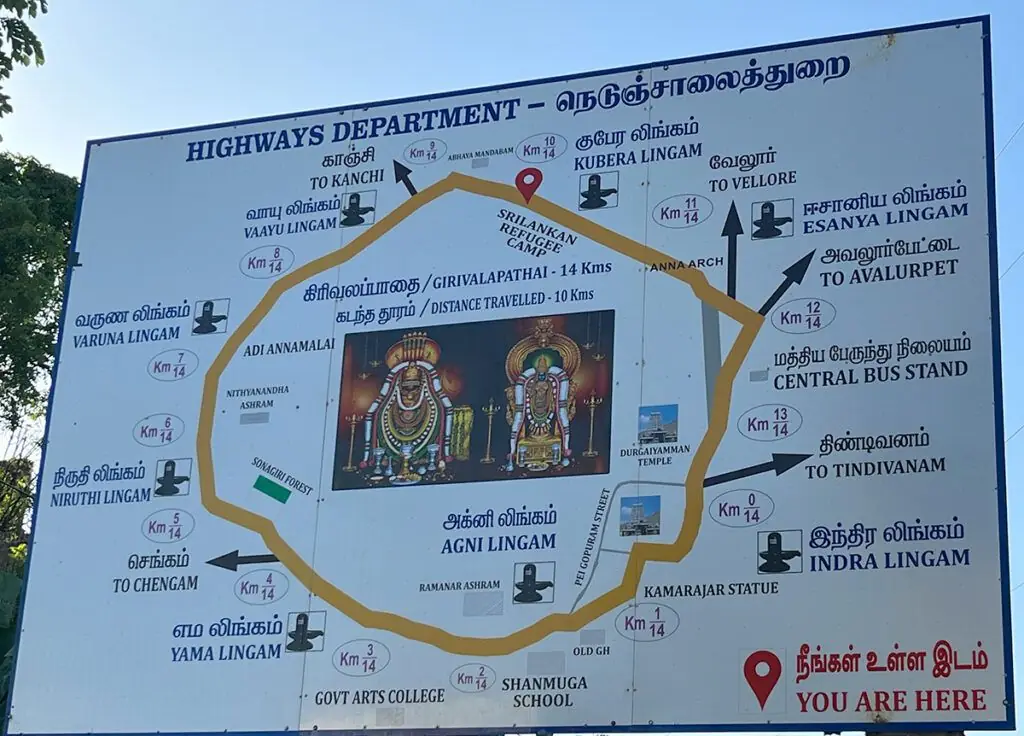
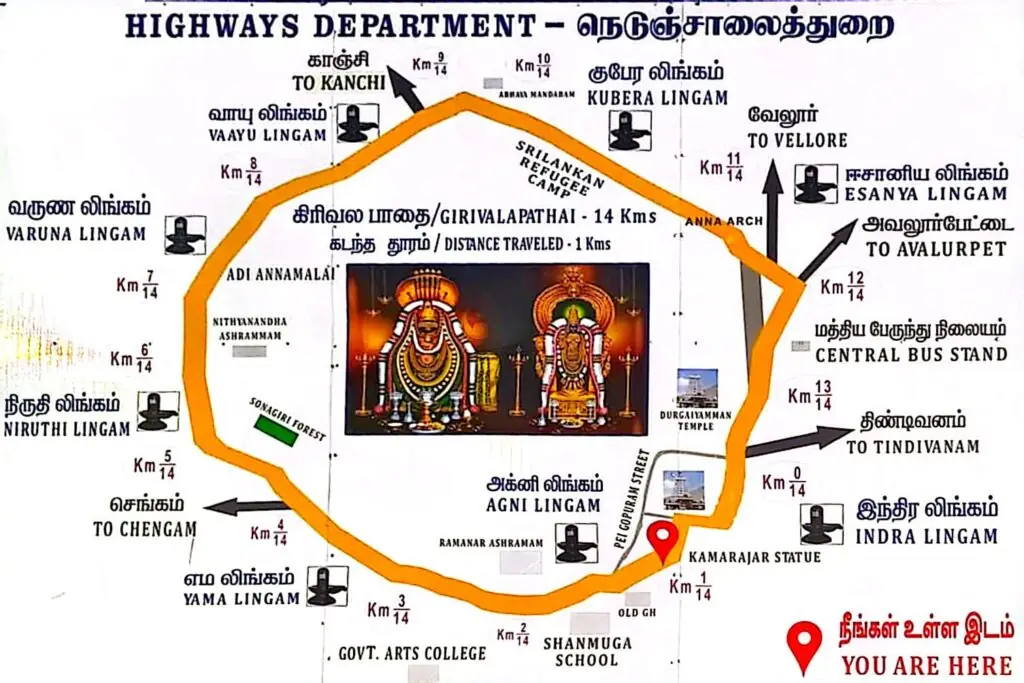
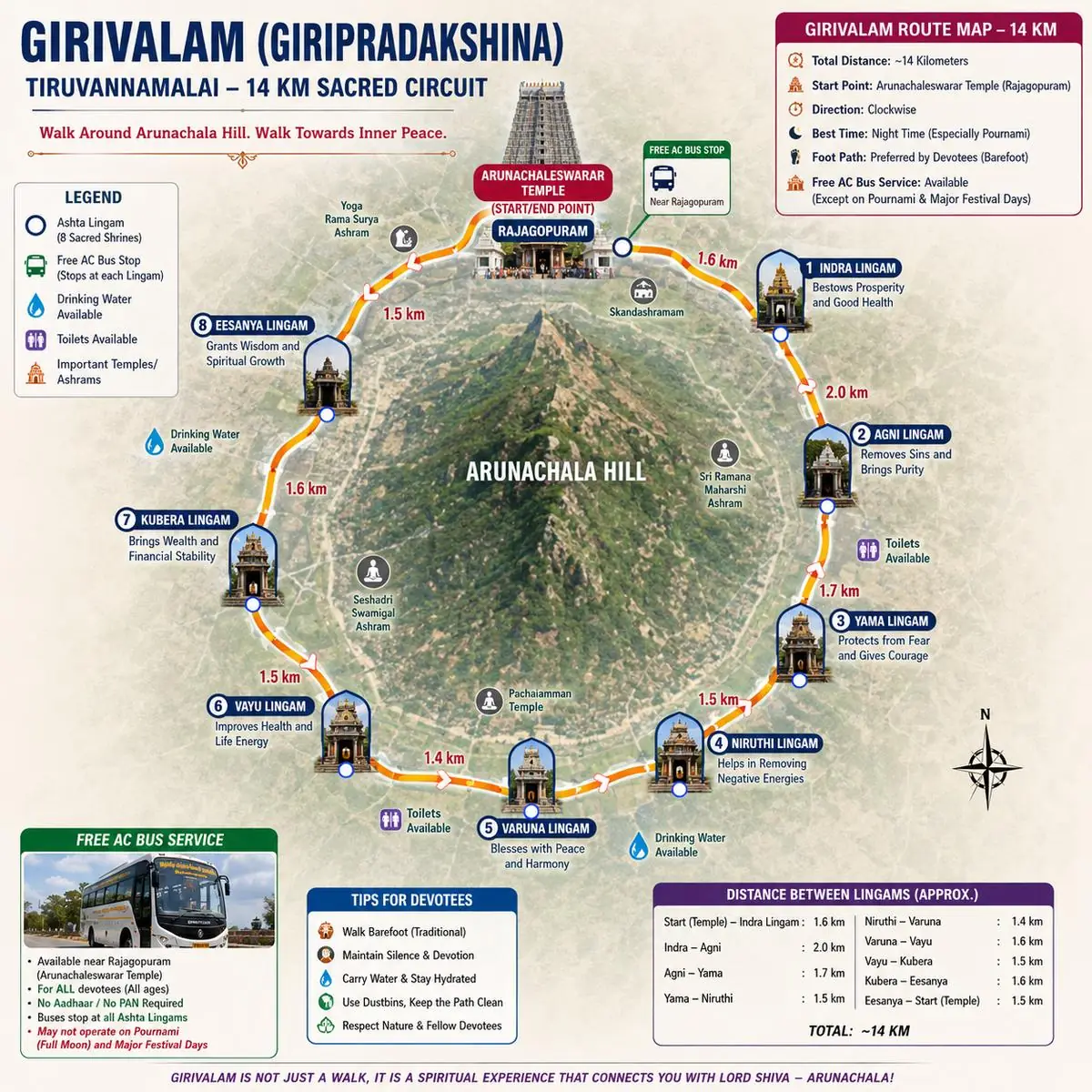
The route is commonly described by local signboards and visitor information as approximately 14 kilometres, although your actual distance can vary depending on where you begin, whether you enter side shrines, and whether you take short detours. It is important not to confuse the hill circuit with a temple procession, a ticketed darshan queue or a mountain climb. You can complete the pradakshina without entering the inner areas of Arunachaleswarar Temple.
Arunachala is revered in Shaiva tradition as a manifestation of Lord Shiva and as one of the five major elemental Shiva centres, associated with fire. The hill is also known through traditional names such as Aruna Hill, Arunagiri and Sona Giri. These names belong to religious and literary usage; the presiding deity at the main temple is generally identified as Arunachaleswarar, the form of Lord Shiva associated with the hill.
For a first visit, the most useful distinction is simple:
Because these activities happen in different places, one timing cannot answer every visitor’s question. A person may walk around the hill at night but still find that a particular temple gate, pooja counter or seva desk follows separate opening hours.
There is no single universal “opening time” for the entire Arunachala circuit in the way there is for a temple gate. Much of the Girivalam route is a public road, so pilgrims do walk during early morning and night hours. At the same time, route access can be affected by police barricades, traffic diversions, crowd-control arrangements, road work, weather and special-day restrictions.
This is why the common question, “Can we start Giri Pradakshina at 1 am?” needs a careful answer. On an ordinary day, people may be seen walking around the route at very early hours, but that does not guarantee that every shrine, toilet facility, food stall, temple gate or transport point will be operating. On Pournami, Karthika Deepam and other busy occasions, the route may have large crowds and controlled movement rather than unrestricted convenience.
The main temple has its own opening, closing, darshan, pooja and aarti arrangements. Those details should never be inferred from the fact that the outer road is accessible. A temple may open a particular entrance at one time, pause general darshan during a ritual, or direct visitors through a queue system that differs from the previous day.
| Activity | What the timing refers to | What may change | What to verify |
|---|---|---|---|
| Girivalam walk | The public road circuit around Arunachala Hill | Traffic control, barricades, lighting, weather and crowd movement | Local police or district advisories and conditions on the day |
| Temple darshan | Entry to view the deity inside Arunachaleswarar Temple | Gate access, queue length, ritual breaks and special entry arrangements | Current temple notice or official administration information |
| Pooja | A scheduled ritual performed by temple priests | Festival sequence, ceremonial requirements and crowd restrictions | The latest daily or festival schedule issued by the temple |
| Aarti or deeparadhana | Lamp offering during a worship service | Timing, location, visibility and access for devotees | Temple announcements rather than a general online timetable |
| Seva or special entry | A booked or designated devotional service | Availability, fee, identity requirements and reporting time | The official booking page or temple counter notice |
If you plan to start at 1 am, treat it as a night journey, not merely an early-morning visit. Travel with at least one companion, carry a charged phone, stay on the recognised route, and confirm whether any temporary restrictions apply before setting out.
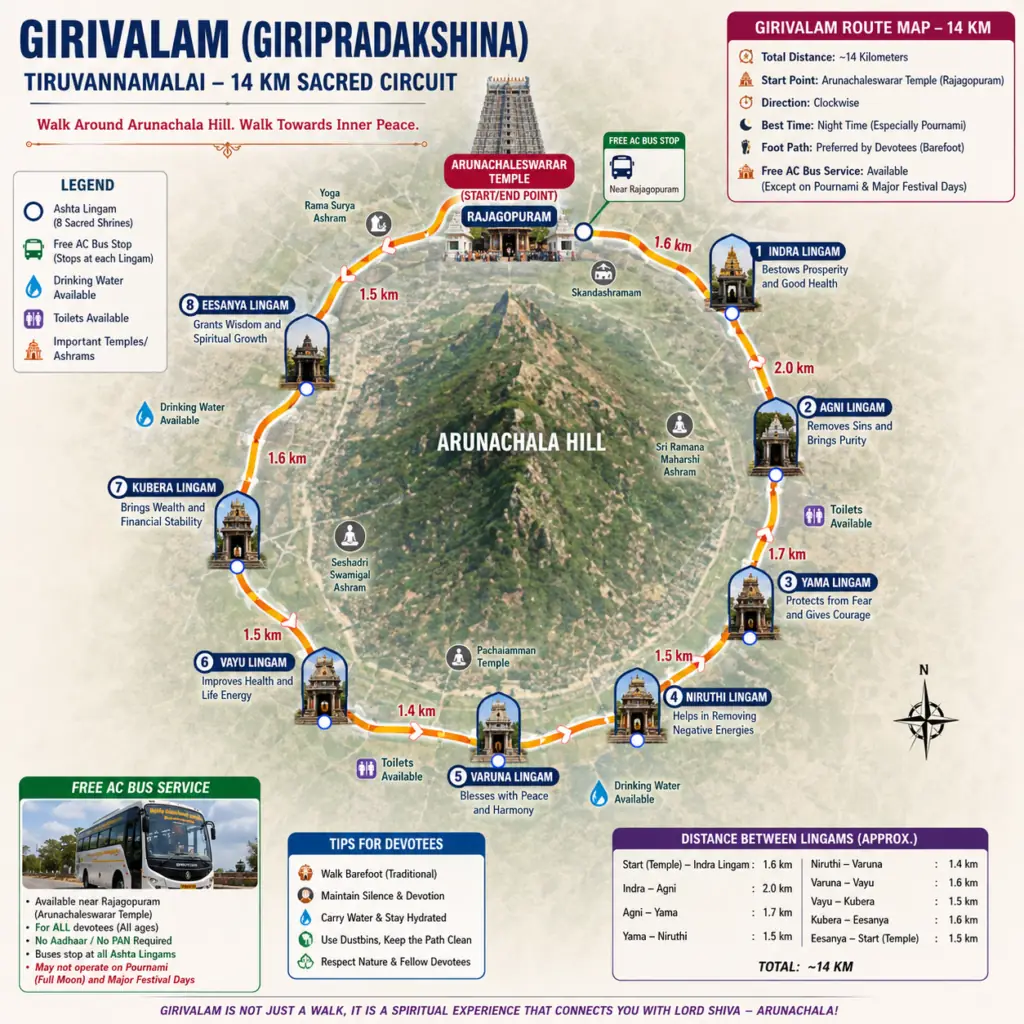
The customary direction is clockwise around the hill. Many devotees begin near Arunachaleswarar Temple, especially around the Raja Gopuram area, but the public circuit can be joined from other points in Tiruvannamalai. Starting elsewhere does not automatically make the walk invalid; what matters to pilgrims is following the established circuit respectfully and completing the intended round.
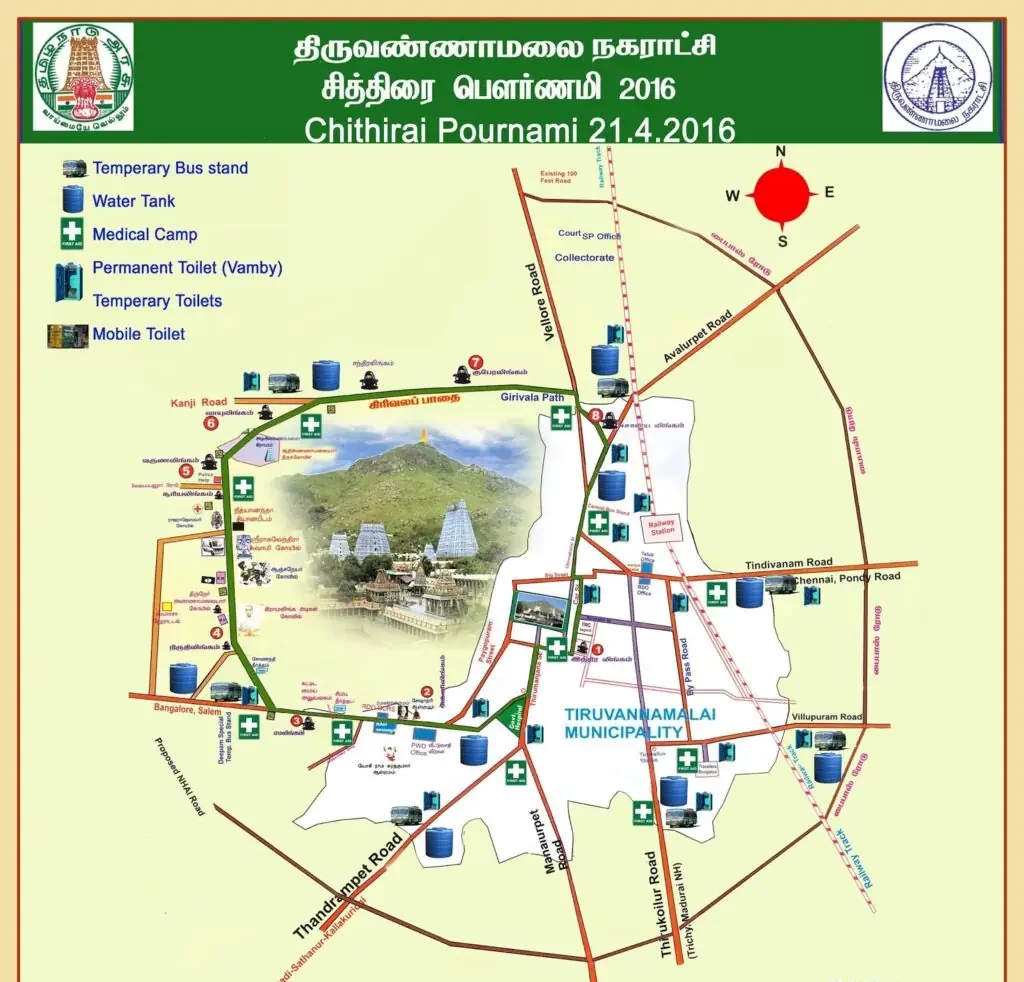
Visitors often use the eight directional lingams as route markers. These are traditionally associated with the eight directions and are commonly identified as Indra Lingam, Agni Lingam, Yama Lingam, Niruthi Lingam, Varuna Lingam, Vayu Lingam, Kubera Lingam and Esanya Lingam. The exact order and local spelling may vary on maps, boards and devotional material, so use the physical signboards on the route rather than relying only on an old video.
Other places frequently included in a visitor’s plan are Adi Annamalai Temple, Ramanasramam, Seshadri Swamigal Ashram and smaller shrines near the circuit. These are not all interchangeable with the main Arunachaleswarar Temple. Each may have its own entry practice, footwear rule, opening period or quiet hours.
A route map is useful, but it should be treated as a planning aid rather than proof that every road condition remains unchanged. A new barricade, one-way traffic order or road repair can make the walking line differ from a map uploaded several years ago. If you are travelling with older family members, children or someone with limited mobility, identify rest points and vehicle access before beginning instead of assuming that every section will be equally easy.
Walking clockwise also helps you follow the traditional flow of pilgrims. Avoid stopping in the middle of a narrow road for photographs, and keep the hill, shrines and other worshippers in mind even when the route feels like an ordinary urban street. Arunachala remains visible from many parts of the circuit, but the walk passes through busy areas as well as quieter stretches.
There is normally no general booking requirement for simply walking the public Girivalam road. That does not mean every part of the visit is unregulated. Entering the main temple, joining a paid seva, using a special darshan queue or attending a festival enclosure may involve different rules.
A practical starting process looks like this:
Rules can differ between the hill road and individual shrines. A place may ask visitors to maintain silence, restrict photography or guide people through a particular gate. Follow the notice displayed at that location, even if a social-media post gives different advice.
Do not assume that a temple trust, a private travel operator or an unofficial booking agent controls all arrangements in the town. The main temple’s administration and government notices are more reliable for formal timings, while local police and civic authorities may control roads and parking.
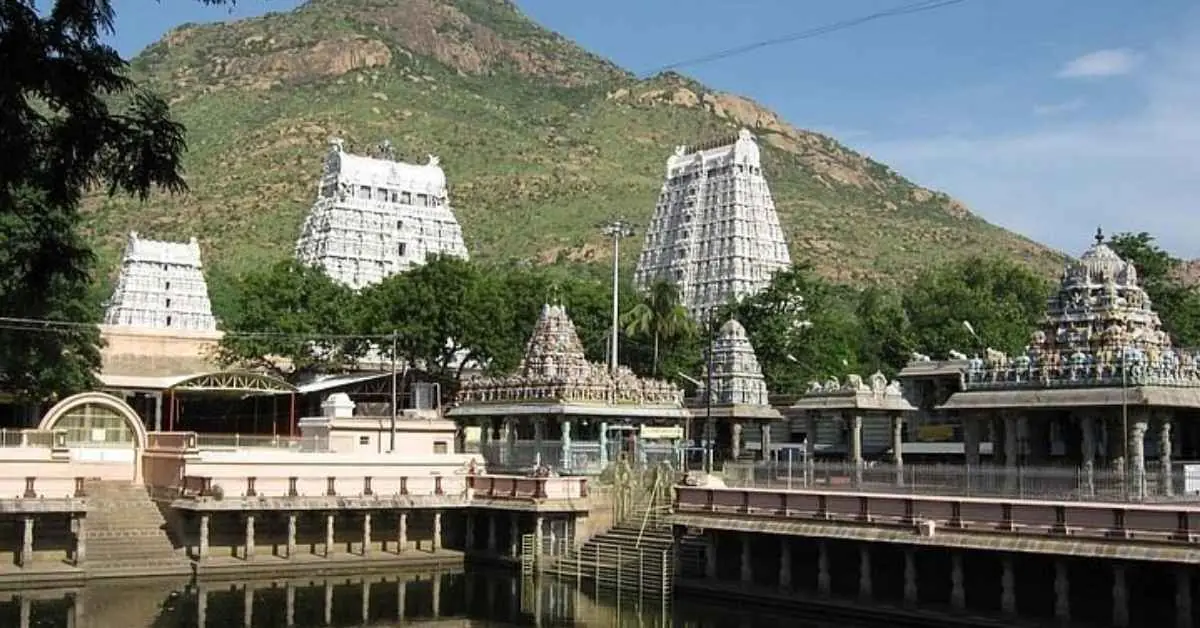
Visitors often search for “Arunachalam temple timings” when their real need is one of four different things. They may want to enter for darshan, attend a specific pooja, watch an aarti or register for seva. These are related but not identical services.
Darshan is the period during which devotees can enter or approach the deity for viewing and worship. The general darshan queue may pause during an important ritual, cleaning, security check or changeover between services. A temple’s outer gate may be open even when access to the sanctum area is temporarily controlled.
Pooja timings refer to the ritual sequence conducted by priests. Shaiva temples commonly have more than one scheduled worship period during the day, but the names, order, reporting rules and public access arrangements are specific to the institution. Do not copy a generic Shiva temple timetable and assume it applies at Arunachaleswarar Temple.
Aarti, also called deeparadhana in many temple settings, involves a lamp or flame offered as part of worship. The aarti may be included within a larger pooja rather than advertised as a separate public event. On a festival day, aarti may occur at a different time or in a different place because of ceremonial processions and crowd movement.
Seva usually means a devotional service or ritual participation. Some sevas are available only through a counter, while others may use an online booking facility if the administration provides one. A seva ticket, where offered, does not necessarily provide unrestricted access to every other temple area.
Before travelling, confirm these points separately:
That separation prevents a common mistake: completing a night Girivalam and reaching the temple expecting immediate darshan, only to find that the relevant gate or ritual queue has a different schedule.
Pournami, the full-moon day, is traditionally important for Girivalam and usually attracts more pilgrims than an ordinary day. The exact crowd experience can vary from one month to another, depending on the weekday, school holidays, weather, local transport and other festival activity. A route that feels manageable on a regular afternoon may become slow and tightly packed during a popular full-moon period.
Karthika Deepam is a particularly significant festival associated with Arunachala. The lighting of the sacred deepam on the hill is connected in Shaiva tradition with the manifestation of Shiva as an endless column of fire. The main Deepam event, temple rituals, hill access, road controls and viewing arrangements follow special-day schedules announced for that year.
For 2026 or any future year, do not rely on a previous Karthika calendar or a video caption. The date and operational details should be confirmed through the latest official temple or district administration notice. Festival timings can include separate information for the temple, the hill, vehicle movement, crowd entry, parking and public viewing areas.
During busy days, queue management may become more important than the printed opening time. Police may create one-way pedestrian flows, close a familiar road to vehicles, move parking outside the central area or limit access to a shrine temporarily. These measures are designed for crowd safety, but they can make the practical route longer than expected.
Plan with extra time if your visit includes:
Hotels and local shops may use the words “special timing” loosely, so ask what the phrase actually means. It could refer to a temple ritual, a road closure, an extended queue or a local business opening period. Only the relevant authority can confirm the detail that affects your visit.
Walking around Arunachala generally does not work like a ticketed attraction. You usually do not need to reserve a place merely to complete the public pradakshina. Booking may become relevant for a special darshan category, a seva, accommodation, a festival facility or another service administered separately by the temple or a government platform.
Availability, fees, reporting times and cancellation terms are changeable. Since no reliable current fee or universal booking rule applies to every service, avoid trusting a message that gives a price without naming the issuing authority and notice date.
For formal temple information, begin with the Tamil Nadu Hindu Religious and Charitable Endowments Department’s official portal. Use the institution listing or service information available there, and check whether the notice is current. The portal is a government source for temple administration, but it may not replace a same-day local announcement about traffic or crowd control.
A sensible online verification routine is:
Offline counters may follow a separate schedule from the temple itself. A counter can close after its daily quota is filled even if the temple remains open. Similarly, an online service may show no availability while general darshan continues normally.
Real-world administrative example: Arunachaleswarar Temple is handled within Tamil Nadu’s HR&CE administrative framework, so a visitor checking a formal seva or temple service should distinguish government-listed information from an unofficial travel listing. This is a verifiable source-led planning approach, not a claim that every service is available online every day. If the official channel does not show a current notice, contact the temple administration or confirm the notice board after arrival rather than assuming last year’s arrangement still applies.
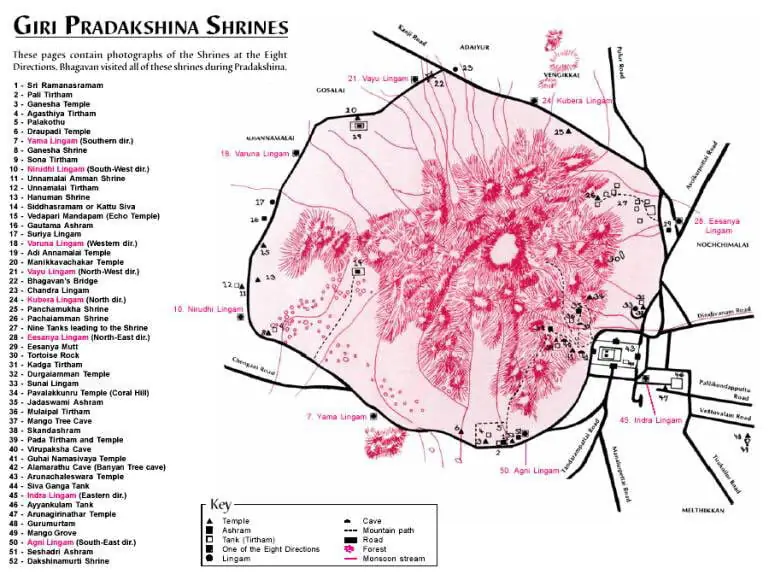
A route of roughly 14 kilometres can take very different amounts of time. At a steady walking pace of about 3 to 4 kilometres per hour, the moving time alone may be around three and a half to five hours.
That is a planning calculation, not an official duration. Darshan, shrine visits, food breaks, photographs, crowd movement and rest stops can extend the visit substantially.
Many people begin before sunrise or after sunset because the road surface can be uncomfortable during the hotter part of the day. Night walking may feel cooler, but visibility, traffic and fatigue require more attention. Carry a torch or use a phone light carefully, wear visible clothing, and avoid walking on the road edge where vehicles pass close by.
Your preparation should match the season and your health. A small bag is usually easier than a heavy backpack. Useful items may include:
There is no universal rule that every pilgrim must walk barefoot around the hill. Some devotees choose to do so as part of their vow, while others use footwear because of heat, stones, traffic or medical needs.
A temple may impose a separate footwear rule inside its premises. Make a decision that is safe for your body and follow each shrine’s displayed instruction.
People with diabetes, heart conditions, joint problems or other health concerns should plan conservatively and speak with a qualified medical professional if a long walk could be risky. Stop if you feel dizzy, unusually breathless, confused or unwell. Spiritual commitment should not be treated as a reason to ignore a medical emergency.
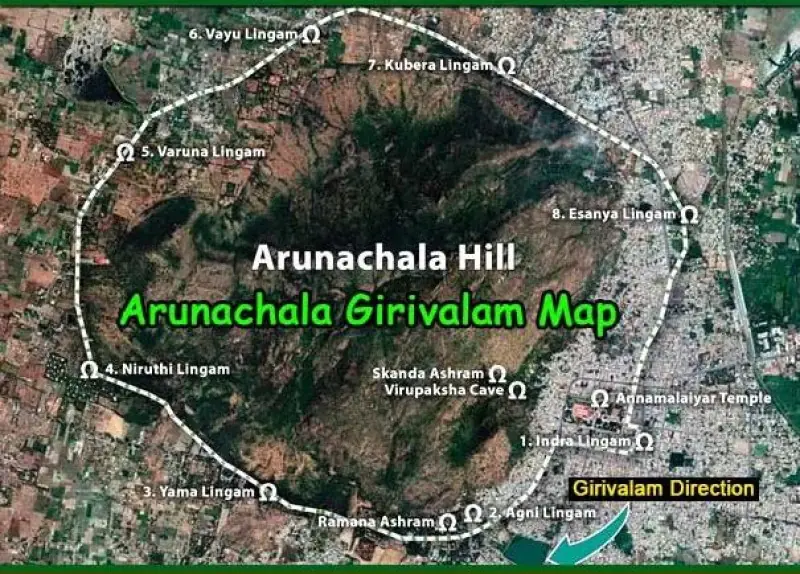
For devotees, the greatness of Arunachala is not limited to the physical landscape. Shaiva tradition describes the hill as a form of Lord Shiva, and the act of moving around it is understood as worship through the body.
Some pilgrims repeat a mantra, maintain silence, carry a personal vow or stop at shrines along the way. Others participate as visitors who appreciate the cultural and spiritual atmosphere without adopting every religious belief.
Traditional Arunachala stories include an account of King Vajrangada. In versions of the Arunachala Sthala Purana, the king is connected with a horse and a mysterious animal during a chase around the hill.
The story links that unintended circuit with the lifting of a curse and spiritual release. Details differ between retellings, so it is better to describe this as a sacred legend rather than a documented historical event involving a verifiable king, horse or death.
Other traditional accounts describe Arunachala as a fire form of Shiva and connect the Karthika Deepam flame with that sacred story. The word “fire” here has theological meaning; it is not a claim that the hill itself is physically made of supernatural flame. Religious narratives use symbols such as light, death, rebirth, pride and release to explain the hill’s spiritual significance.
People commonly speak of the benefits of pradakshina in terms of peace, discipline, devotion, gratitude and mental focus. Those are personal or religious experiences, not guaranteed outcomes. Walking can also provide ordinary physical exercise, but it should not be presented as a cure for illness or as a promise that a particular wish will be fulfilled.
Respectful participation leaves room for different beliefs. You may walk silently, pray in your own tradition, observe the ritual as a cultural practice or simply accompany family members.
Avoid making absolute claims about what will happen to every person after completing one round. The meaning of the journey belongs partly to the devotee and partly to the living tradition of the place.
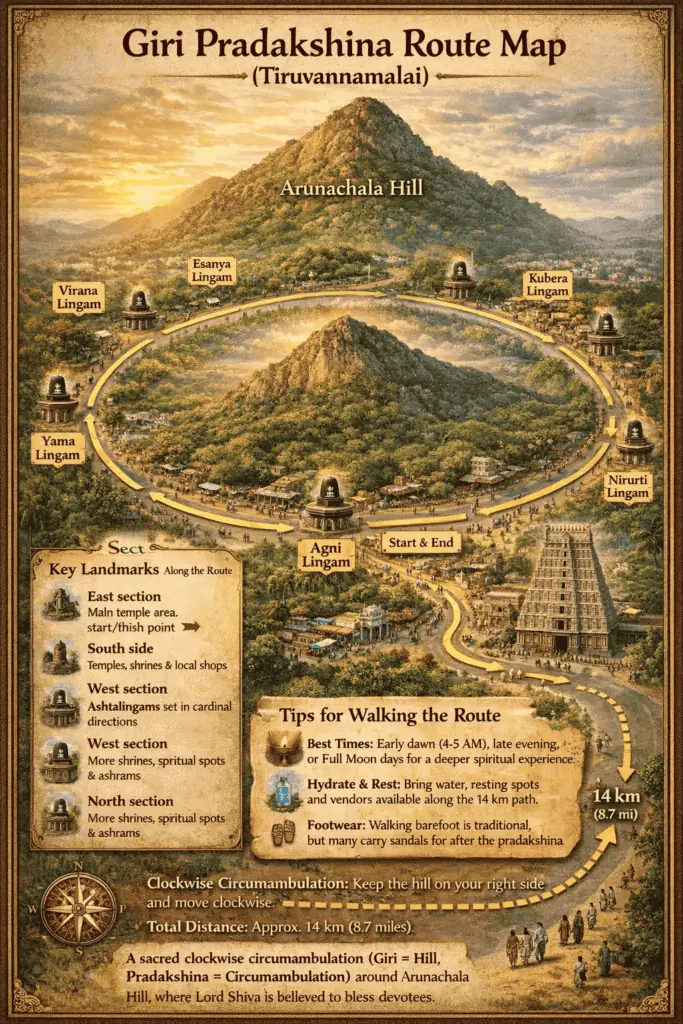
A first-time visitor will usually have a smoother experience by separating the trip into phases instead of attempting every activity at once. The following is an illustrative planning example, not a fixed temple timetable or a claim about a particular festival date.
Suppose you arrive in Tiruvannamalai on an ordinary weekday and want both the hill circuit and temple darshan. First, check the latest temple notice and local road situation.
Then decide whether your priority is a cooler early walk or a quieter temple visit. Starting the circuit before sunrise may reduce heat, but the main temple’s darshan availability still needs separate confirmation.
After reaching the starting point, note the road direction and identify a practical meeting place in case members of your group become separated. Complete the circuit at a pace that allows rest. If you want to visit Adi Annamalai Temple or the eight directional lingams, include those stops in your estimated duration rather than treating them as optional additions at the last minute.
Once the walk is complete, reassess your energy before joining a temple queue. A person who has walked for several hours may need food, water and rest before entering a crowded darshan line. If you have a booked seva, follow the ticket’s reporting instructions instead of assuming you can arrive whenever general darshan is open.
For a special day, change the plan:
This separation between route planning and temple planning reflects the real administrative structure of the visit. The hill circuit, temple precinct, festival stage, traffic network and booking counter may all operate under different instructions. Confirming each part is more dependable than searching for one supposedly permanent “Arunachalam timing.”
Timing information is most useful when it changes your decisions before the journey begins. A quick verification on the morning before departure can prevent confusion, especially if you are travelling from another city or carrying a group booking.
Check the date first. A regular weekday, Sunday, Pournami, Maha Shivaratri period and Karthika Deepam day should not be planned in the same way. Even if the ritual sequence is familiar, the road and queue arrangements may be different.
Then confirm the specific service you need. “Temple open” does not necessarily mean “special pooja available.” “Darshan available” does not necessarily mean “seva counter open.” “Girivalam possible” does not necessarily mean that parking, public transport or every side shrine is operating normally.
Use this final checklist:
Take screenshots of important notices because network access may be unreliable in crowded areas. If a notice has no date, no issuing authority or no clear location, treat it as unconfirmed. A message forwarded in a group can be useful as a clue, but it should not be the final basis for a paid booking or a long-distance journey.
The commonly described circuit is about 14 kilometres, but the total time depends on pace, stops, shrine visits, weather and crowd conditions. A moving-time estimate of roughly three and a half to five hours is reasonable for planning, while a complete visit can take longer.
People do undertake the public hill circuit during late-night and early-morning hours, but there is no single universal night-opening rule for every part of the route. Confirm local restrictions, travel with companions and remember that temple gates, facilities and pooja counters may follow separate timings.
Choose a clear landmark near the recognised circuit, follow the customary clockwise direction and stay on the public walking route. Starting near Arunachaleswarar Temple is common, but the circuit can be joined from other points. If you also want temple darshan or seva, plan those as separate activities.
Simply walking the public Girivalam route generally does not require a booking. Online or offline registration may apply to a special darshan, pooja, seva, accommodation or festival facility. Check the official temple administration information for the particular service rather than assuming one rule covers the entire visit.
Devotees may understand the walk as an act of prayer, discipline and surrender, and many describe personal spiritual benefits. The traditional stories should not be treated as guaranteed predictions for every visitor. Physically, it is a long walk, so rest, hydration and sensible pacing matter.
Arunachalam Giri Pradakshina becomes easier to plan once the hill circuit is separated from temple darshan, pooja, aarti and seva. Check the current official schedule, identify whether your date is a regular or special day, and allow extra time for crowds, traffic and rest.
Before leaving home, verify the latest notice through the appropriate temple or government channel. That small step can turn a confusing visit into a calm and respectful journey around Arunachala.





