Physical Address
304 North Cardinal St.
Dorchester Center, MA 02124
Physical Address
304 North Cardinal St.
Dorchester Center, MA 02124
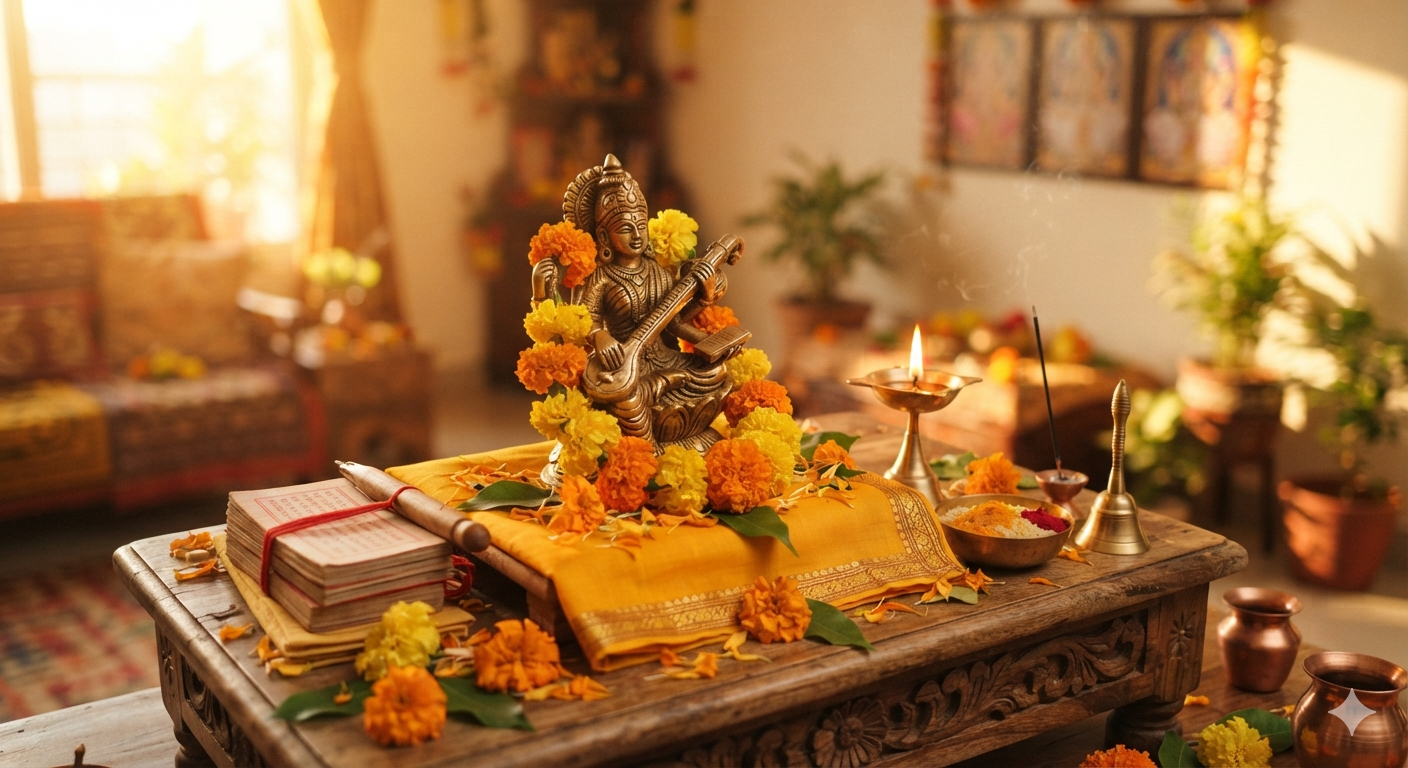
Saraswati Puja 2026 falls on Friday, January 23, and if you’ve ever tried to nail down the exact puja timing for this festival, you already know the frustration. Every website seems to list a slightly different muhurat, some priests tell you one thing, your grandmother tells you another. This guide sorts out the actual timings, walks you through the puja step by step, and answers the questions that most articles skip entirely — like why the goddess is dressed in white while everyone around her wears yellow.
You’ll also find something most guides leave out: the mythological reason this specific day, out of 365, belongs to Saraswati.
Let’s get the basics locked in first. Saraswati Puja 2026 — also called Vasant Panchami or Basant Panchami — falls on Friday, January 23, 2026, across nearly all of India. This is confirmed consistently by DrikPanchang and multiple Panchang-based sources.
The Panchami Tithi itself begins at 2:28 AM on January 23 and runs until 1:46 AM the following day. That’s a long window, and it’s exactly why muhurat timings differ so much between sources.
Here’s the thing nobody explains clearly: Panchami Tithi and “puja muhurat” aren’t the same window. The tithi is a lunar calendar measurement — it tells you when the fifth day of Shukla Paksha in Magha month is technically active. The muhurat is a narrower, astrologically preferred slice within that window, and different Panchang calculators slice it differently.
You’ve probably noticed this if you’ve compared even two or three websites. One site says the muhurat runs 6:46 AM to 12:32 PM. Another lists 7:15 AM to 12:50 PM. A third says 7:13 AM to 12:33 PM. None of them are “wrong” exactly — they’re calculated using slightly different sunrise data, city coordinates, and methods for determining Purvahna Kala (the morning-to-midday period).
Here’s a quick comparison so you can see the spread for yourself:
| Source | Muhurat Window (New Delhi, IST) |
| Drik Panchang (via city puja calculator) | 6:46 AM – 12:32 PM |
| SmartPuja | Multiple shubh muhurats; check city-specific timing |
| General Panchang aggregators | 7:15 AM – 12:50 PM |
| Kreditbazar / regional guides | 7:13 AM – 12:33 PM |
Notice something? Every single window falls inside the broader Purvahna Kala period — sunrise to midday. That’s not a coincidence.
If you ask a purohit rather than a website, you’ll usually get a simpler answer than any of the tables above. As long as Panchami Tithi is active, the puja is valid — and Drik Panchang itself notes that Purvahna Kala, the stretch between sunrise and midday, is the traditionally preferred window because that’s when most schools, colleges, and households across India perform the ritual anyway.
So don’t stress over the exact minute. If you start your Saraswati Puja between 7 AM and noon on January 23, you’re well within the accepted window used by most temples and families. For anything more precise — say, a formal ceremony at a specific mandir — it’s worth calling ahead and asking their priest directly, since temple-specific schedules can shift based on crowd size and local sunrise times.
Most articles jump straight into rituals without ever explaining where this festival actually comes from. That’s a shame, because the origin story is genuinely interesting.
According to Hindu mythology, after Lord Brahma created the universe, he looked around and found it eerily silent — chaotic, formless, without sound or voice. So he sprinkled water from his Kamandalu, and from that act, a radiant, four-armed goddess appeared. She held a veena, a book, and a rosary. When she played the veena, the universe found its voice for the first time. That goddess was Saraswati, and this is the moment Hindus commemorate on Vasant Panchami.
There’s a second, less-discussed legend too — one popular in Bengal — which holds that it was on this very day that Saraswati bestowed wisdom upon the classical poet Kalidas, transforming him from a simpleton into one of Sanskrit literature’s greatest voices. Whether or not you take the story literally, it explains why poets, writers, and musicians treat this day as personally significant, not just students preparing for exams.
The name itself is simple Sanskrit. “Vasant” means spring, and “Panchami” refers to the fifth day of a lunar fortnight. Put together, it marks the fifth day of Shukla Paksha (the waxing moon phase) in the Hindu month of Magha — which typically lands in late January or early February.
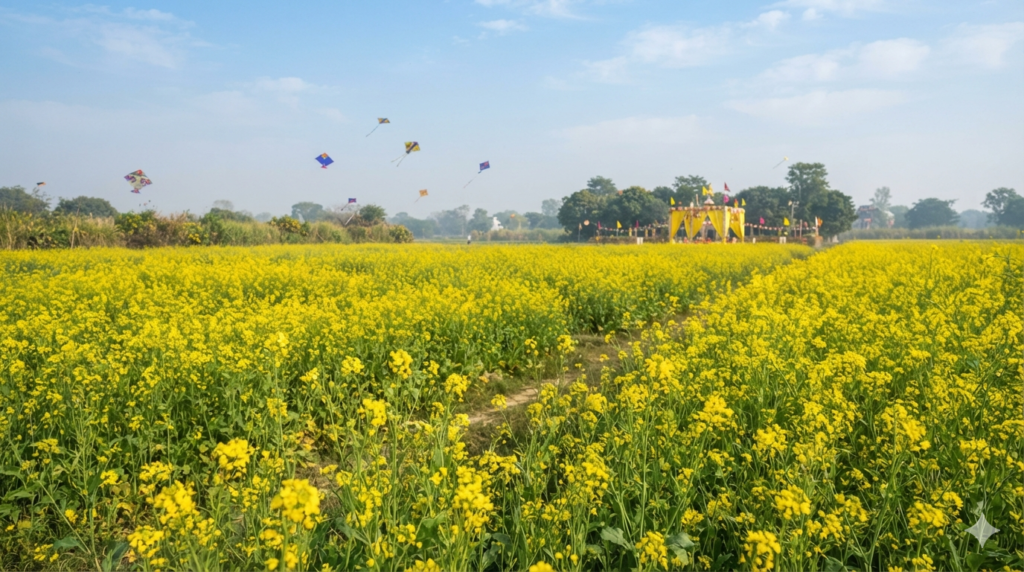
That timing isn’t incidental. It sits right at the point where North India’s winter starts loosening its grip, and mustard fields across Punjab and parts of Uttar Pradesh begin turning a deep, unmistakable yellow. The festival essentially fuses a seasonal marker with a spiritual one.
Now for the part most people actually came here for — how to do the puja properly, without missing a step.
Traditionally, the day starts early, ideally during Brahma Muhurat (roughly 90 minutes before sunrise). Bathe and put on clean clothes — yellow or white are both considered appropriate, though yellow is far more common in practice.
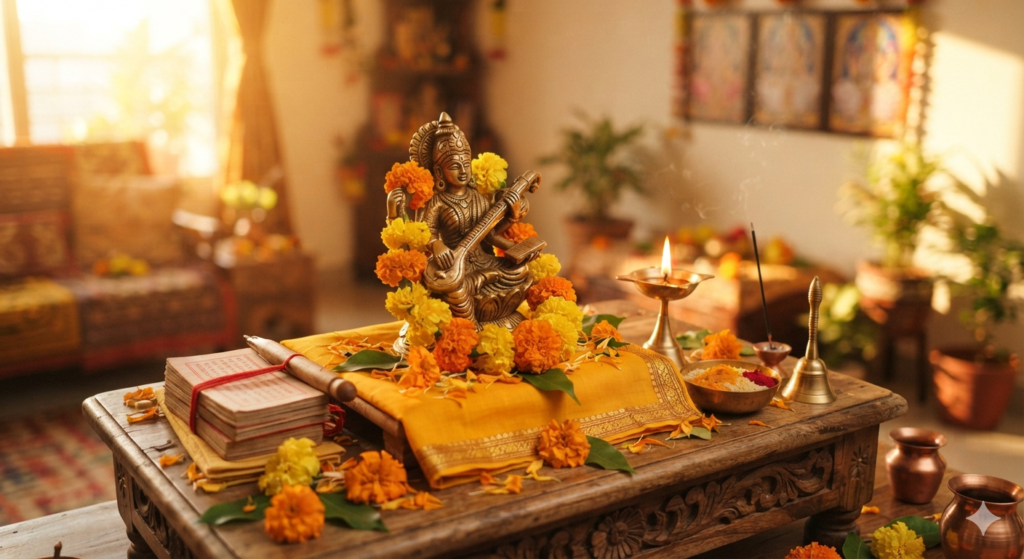
Set up your puja space by placing an idol or image of Saraswati on a yellow cloth. If you have books, musical instruments, or art supplies at home, keep them nearby. This isn’t decorative — it’s the whole point of the ritual.
A typical Saraswati Puja offering table includes:
Each item ties back to something specific. The books and instruments represent the domains Saraswati governs — learning and art. The yellow flowers echo the seasonal color. Turmeric-rice is a purification offering common across many Hindu pujas, not unique to this one, but it fits the theme of clarity and cleansing.
Once the offerings are set, the actual worship begins with mantra chanting, followed by aarti. Families with young children often use this moment for Vidyarambh — literally “the beginning of learning” — where a child writes their first letters, guided by a parent or grandparent, right at the goddess’s feet. In parts of South India this same ritual is called Vidyarambham or Akshar-Abhyasam, and in Nepal it’s known as Haate Khori.
A quiet but widely followed custom: many students avoid studying or even opening a book on this day until after the puja concludes. The idea is a symbolic surrender — you set your ego about your own effort aside for a few hours and simply ask for the goddess’s blessing instead.
Nearly every article about this festival prints the famous Ya Kundendu shloka. Almost none of them explain what it’s actually saying. Let’s fix that.
The shloka opens by describing Saraswati as fair like jasmine, the moon, and frost (Kundendu Tusharahara Dhavala) — an image of complete purity. It goes on to describe her wearing white garments (Shubhra Vastra Avrita), her hands adorned with the veena (Veena Vara Danda Manditakara), and her seat on a white lotus (Shweta Padmasana). The final lines ask her to protect the devotee and remove all dullness of the mind — “Nihshesha Jadyapaha” literally translates to “the remover of all lethargy and dullness.”
That last phrase is worth sitting with for a second. This isn’t just a prayer for knowledge in the abstract — it’s a prayer against mental fog, procrastination, and sluggish thinking. If you’ve ever chanted this mantra before an exam without knowing what it meant, that context probably makes it land differently.
If the full shloka feels like a lot to memorize, the short-form mantra works just as well for daily use:
“Om Aim Hreem Kleem Mahasaraswati Devyai Namah”
Many students recite this quietly before opening a book to study or before an exam, not just on Vasant Panchami itself. It’s short enough to become a habit rather than a once-a-year recitation.
Here’s a contradiction almost nobody addresses directly, even though it’s staring right at you if you pay attention. Saraswati herself, per the shloka above, is described in white. Yet the entire festival is soaked in yellow — clothes, flowers, sweets, decorations. Why the mismatch?
Yellow’s dominance has nothing to do with the goddess’s iconography and everything to do with the season. Late January is when mustard fields across North India hit peak bloom, turning entire landscapes gold. Yellow, in this context, represents the vibrancy of nature waking up after winter — energy, brightness, and the start of a new agricultural cycle. It’s also considered Saraswati’s favorite color in popular tradition, associated with knowledge and light rather than purity specifically.
White, on the other hand, belongs to Saraswati’s actual depicted form — her clothing, her lotus seat, her overall aesthetic in classical texts and temple murals. White in Hindu symbolism generally signals purity, peace, and the absence of worldly distraction, which fits a goddess associated with clear, uncluttered thinking.
So really, you’re looking at two separate color traditions running in parallel: one describing the goddess as she’s depicted, and one describing how devotees choose to celebrate her, tied to the season rather than her portrait. Both are correct. They’re just answering different questions.
Short answer: yes. But it’s worth understanding why, rather than just accepting the claim.
Vasant Panchami is classified as an Abujha Muhurat — a Sanskrit term meaning “self-evidently auspicious.” Days with this status don’t require individual horoscope-matching or consultation with an astrologer to determine if the timing suits a specific couple or family. The entire day is considered favorable by default.
There are only a handful of days on the Hindu calendar with this status. Akshaya Tritiya, which falls in April or May, is probably the most well-known comparison — it carries the same “no muhurat-checking required” quality. If you’ve ever heard someone say Akshaya Tritiya is a great day to buy gold or start something new without consulting a Panchang, Vasant Panchami works on the exact same logic.
Because of its Abujha status, families use Vasant Panchami for more than just Saraswati Puja. Common activities include:
That said, if you’re planning something as significant as a wedding, it’s still smart to double-check auspicious hours specific to your city and family traditions with a local priest, since regional customs can layer additional preferences on top of the Abujha status.
Saraswati Puja doesn’t look the same everywhere, and that’s part of what makes it interesting. Here’s a real example worth knowing about.
In Kolkata, the festival takes on a personality almost entirely its own. Locally called Saraswati Pujo, it’s celebrated by students with such enthusiasm that it’s earned the nickname “Bengali Valentine’s Day” — young people dress in traditional yellow and white attire, go pandal-hopping across the city, and the day carries a distinctly social, youthful energy alongside the religious observance, according to Outlook Traveller.
Schools take this seriously too. At Park Institution in Shyambazar, headmaster Supriyo Panja described the school’s 2025 pandal theme, built entirely around encouraging reading in the smartphone era: “The goal is to inspire students to read more books, especially as many are increasingly distracted by mobile phones and the internet,” he told Millennium Post. Nearby, Taki Boys’ School built its pandal around the evolution of books — tracing the journey from palm-leaf manuscripts to modern e-books, with materials sourced from the Sunderbans. It’s a good reminder that this festival isn’t frozen in ritual; schools actively use it to make a point about learning that’s relevant to the year they’re in.
Beyond Kolkata, West Bengal, Odisha, and Assam all organize large-scale community Saraswati Puja pandals, often rivaling the scale of Durga Puja celebrations in decoration and footfall. Schools and colleges typically treat this as one of the year’s most important events, with elaborate idol installations and cultural programs running for a day or two.
In Punjab and Haryana, the festival coincides almost perfectly with mustard bloom season, and kite flying becomes a major part of the celebration — skies over cities like Amritsar fill with colorful kites as families combine the seasonal and spiritual elements of the day.
South India places less emphasis on grand Saraswati idols (Navaratri is the bigger Saraswati-worship period there) but treats Vasant Panchami as an ideal day for Vidyarambham — a child’s first formal step into education. Nepal follows a nearly identical custom under the name Haate Khori, observed widely in schools and temples across the country.
A few practical details to round things out before you head into the day.
Kesari halwa, sweet saffron rice, boondi laddoo, and khichdi are the standard offerings and festive foods, all sharing that same golden-yellow hue tied to the season. In parts of Eastern India, offering Ber (jujube fruit) to the goddess is also customary.
If you’re planning to visit a temple for Saraswati Puja rather than performing it at home, it’s worth calling ahead. Crowd sizes swell dramatically at popular mandirs on this date, and some temples adjust their darshan hours specifically to manage the rush. A five-minute phone call the day before can save you an hour of standing in line.
Whether you mark the day with a full puja at home, a visit to a crowded pandal in Kolkata, or simply by writing your name for the first time as a child at your parent’s side, Vasant Panchami keeps showing up for the same reason every year — it gives you permission to start something. What will you begin this January 23?