Physical Address
304 North Cardinal St.
Dorchester Center, MA 02124
Physical Address
304 North Cardinal St.
Dorchester Center, MA 02124
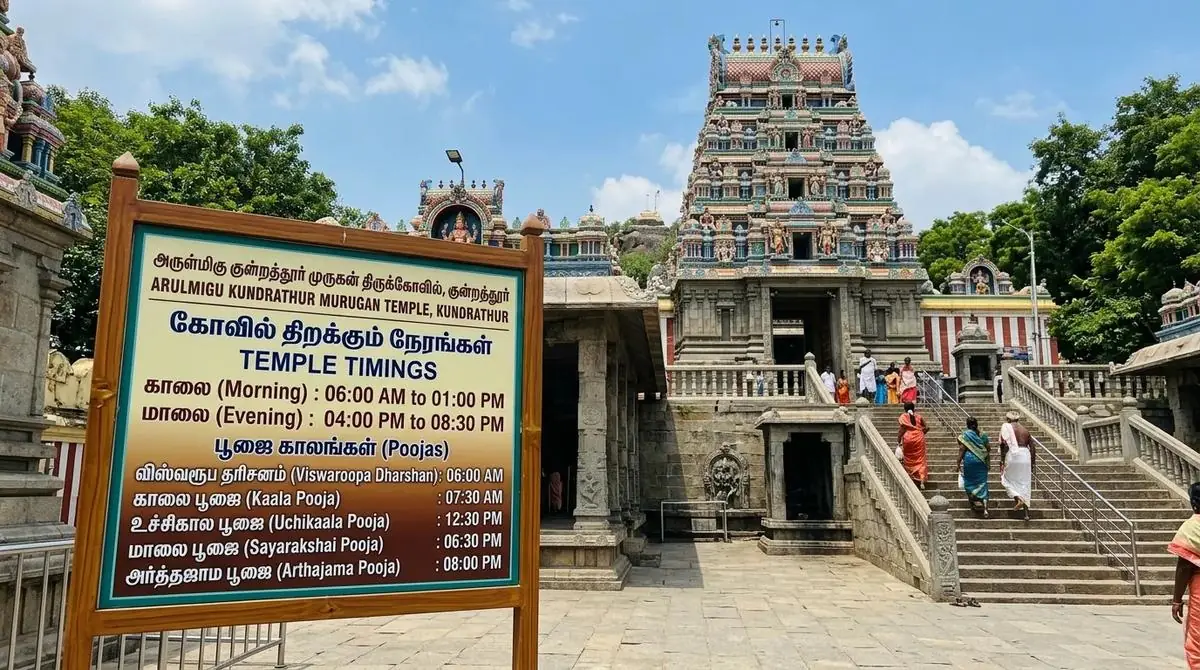
Kundrathur Murugan Temple is a well-known hill shrine near Chennai, valued for its peaceful setting, traditional worship, and strong connection with Lord Muruga devotees. The climb to the sanctum, the Tamil devotional atmosphere, and the presence of related shrines make a visit meaningful for families, pilgrims, and first-time visitors alike.
Timings, pooja schedules, entry arrangements, and festival procedures can change on busy days, so planning matters. This article explains the temple’s background, darshan expectations, steps, rituals, travel considerations, booking questions, and practical ways to confirm the latest information before you leave home.
Kundrathur Murugan Temple stands on a small hill in Kundrathur, in the western part of the Chennai metropolitan region. The surrounding area has grown rapidly, yet the temple retains the feel of a traditional Tamil hill shrine. Devotees approach the entrance, begin the climb, and gradually leave behind the traffic and commercial activity of the town below.
The hill itself is an important part of the experience. Unlike a large temple complex built entirely on level ground, this shrine asks visitors to make a physical ascent before reaching the main worship area.
For many devotees, the climb represents an act of prayer rather than simply a route to the sanctum. Elderly visitors, young children, and people with mobility concerns may need to plan the ascent slowly and carry water where permitted.
The presiding deity is Lord Muruga, also called Skanda, Subramanya, Karthikeya, or Murugan. In Tamil devotional traditions, Muruga is associated with courage, wisdom, protection, youth, and victory over negative forces. His spear, the vel, is a central symbol in Murugan worship, and many devotees come to pray for clarity, family welfare, health, education, marriage, or relief from personal difficulties.
Kundrathur is also known for its wider religious and cultural importance. The locality is associated with Tamil Saivite traditions and with Sekkizhar, the author of the Periya Puranam.
That association gives the area a literary and devotional identity beyond the hill temple itself. Visitors interested in temple history may wish to explore Kundrathur as a sacred place rather than treating the visit as a quick sightseeing stop.
People often ask what is special about Kundrathur Murugan Temple. There isn’t one single answer.
Its appeal comes from the combination of a hilltop location, a traditional Murugan sanctum, the climb through the temple approach, and the devotional energy created by regular worshippers. The setting feels distinct from a busy urban shrine at street level.
The temple is connected in popular devotional understanding with Muruga’s presence on a hill, a recurring idea in Tamil religious culture. Murugan temples at places such as Tiruttani, Tiruchendur, Palani, Swamimalai, Pazhamudircholai, and Tirupparankundram are often discussed together as important centres of Muruga worship, although each has its own history, architecture, rituals, and local traditions. Kundrathur belongs to the same broad devotional landscape without being one of the six major abodes traditionally called the Arupadai Veedu.
Some local accounts refer to the shrine’s Chola-period connections, including links with Kulothunga Chola traditions. Such historical claims should be read with care because temple histories are preserved through inscriptions, local records, oral tradition, and devotional literature, and different sources may present details differently. If you’re interested in the origin of the shrine, ask the temple office or consult official heritage or Hindu Religious and Charitable Endowments records rather than relying on an unverified social media post.
Devotees may also notice features common to South Indian temple design: a defined entrance, a main sanctum, circumambulatory space or prakara, subsidiary shrines, lamps, bells, and images connected with Saivite worship. Depending on the day and access arrangements, you may see worship offered at shrines associated with Vinayaka, Valli, and other deities. The exact arrangement and visitor access can be affected by renovation, crowd control, or ritual activity.
There is no safe reason to publish an unverified fixed timetable for this temple. Online directories and old visitor posts sometimes display opening and closing hours, but those figures may not reflect the current schedule. Temple timings can change during festivals, special abhishekam, maintenance, VIP visits, local restrictions, or administrative decisions.
For that reason, check the latest notice through the temple office, an official temple communication channel, or the Tamil Nadu Hindu Religious and Charitable Endowments Department before travelling. The department’s official HR&CE Tamil Nadu portal can be a useful starting point for identifying temple-related information, though every detail may not always be available online in the same format.
Darshan means viewing or receiving the presence of the deity. At a hill temple, darshan may be straightforward on an ordinary weekday but slower during weekends, public holidays, Tamil months associated with Murugan worship, and special festival days. The queue may also become longer around the time of a major pooja, when devotees wait to see the deity after the ritual is completed.
A practical visit plan looks like this:
Don’t confuse the time printed on an old map listing with an official schedule. A phone call or current notice can save you an unnecessary journey, particularly if you’re travelling from another part of Chennai or from outside the city.
Murugan worship commonly includes several forms of daily service, although the exact sequence and timing at Kundrathur may vary. A typical temple day can involve opening rituals, cleaning and decoration of the deity, abhishekam, alankaram, archana, deeparadhanai, and closing procedures. These names describe common Hindu temple practices; they should not be treated as a confirmed timetable for this particular shrine unless the temple publishes it.
Abhishekam is the ritual bathing of the deity with permitted substances such as water, milk, sandalwood preparation, or other offerings according to temple practice. The service may be conducted by the temple’s authorised priests. Visitors may be allowed to watch, sponsor, or receive the benefits of the ritual depending on the day’s rules and the type of ticket or offering available.
Alankaram refers to the decoration of the deity after ritual bathing. Muruga may be adorned with flowers, sandal paste, ornaments, and festival clothing. The appearance of the shrine can therefore differ between an ordinary day, a Friday, a special Tamil month, and a major festival.
Archana is a personal prayer service in which a devotee’s name, star, or other details may be recited according to the temple’s accepted procedure. If you plan to book archana, ask the counter staff what information is needed. Some temples ask for the devotee’s name and birth star in Tamil or English; others may use a standard ticket without collecting extensive personal details.
Deepa aradhanai, the offering of light, is often an important moment for devotees. During aarti or deeparadhanai, crowd movement may pause, and the queue can become temporarily slow. Keep your phone away if photography is prohibited, and follow instructions from priests, volunteers, or temple staff.
If your priority is a calm visit, an ordinary weekday outside major festival periods may be more manageable than a Saturday, Sunday, or public holiday. If your priority is witnessing a particular ritual, confirm the service rather than assuming it takes place at the same hour every day. Pooja schedules can shift because priests may be engaged in a special service, a festival procession, or a temple function.
| Visit purpose | What to verify | Planning suggestion |
|---|---|---|
| Regular darshan | Opening hours and queue access | Choose a non-festival weekday where possible |
| Abhishekam | Service timing, sponsorship rules, and ticket availability | Reach before the announced reporting time |
| Archana | Counter location, fee, and details required | Carry the devotee’s correct name and star information if requested |
| Festival visit | Special entry, crowd control, and procession route | Expect delays and follow temporary instructions |
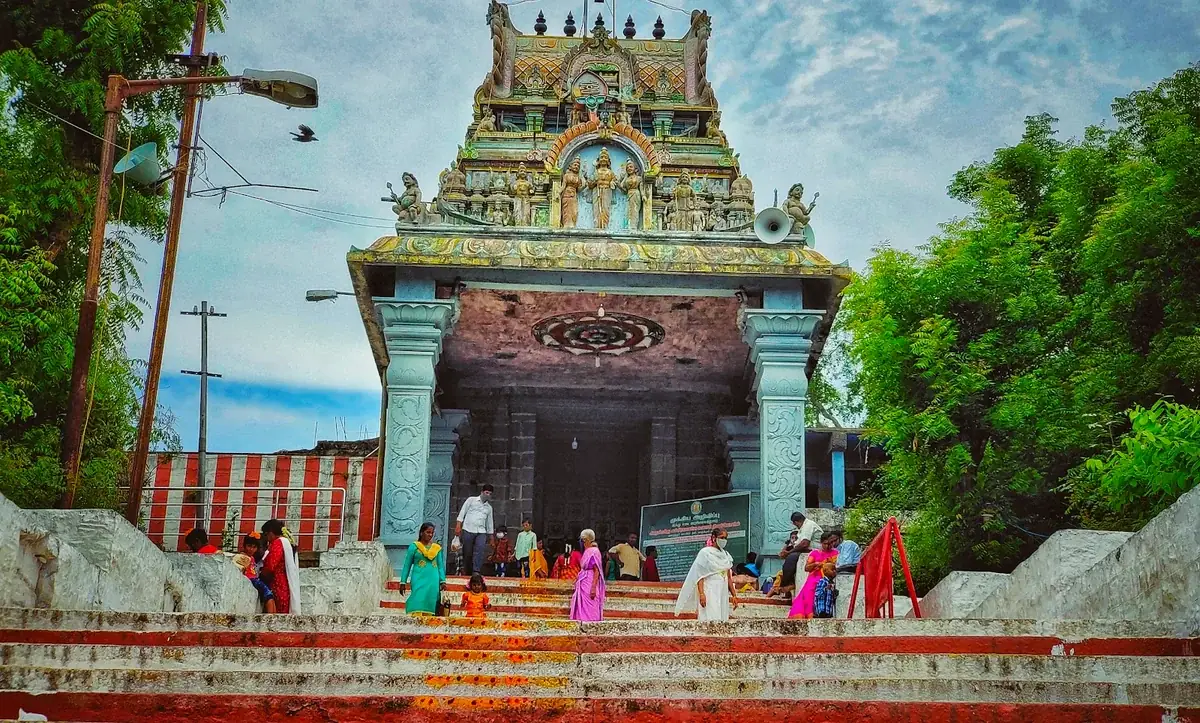
The number of steps is one of the most searched questions about the temple. Many local references commonly describe the climb as having 84 steps. Because step counts can be reported differently after repair work, changes in approach routes, or different starting points, treat that number as a commonly cited reference rather than a guaranteed measurement for every visitor route.
The practical point is that the climb is noticeable but manageable for many visitors at a comfortable pace. You don’t need to rush.
Pause at suitable places, especially if you’re travelling with older family members or children, and avoid blocking the path while resting. The stone or concrete surface may become slippery during rain, so footwear with a secure grip is sensible for the approach.
The climb can feel more demanding during hot afternoons. Chennai’s heat, direct sunlight, and crowded steps can make a short ascent tiring.
Early morning or evening may be more comfortable, but only if the temple’s current darshan schedule supports that timing. A cooler hour isn’t useful if the main shrine is closed or a ritual temporarily restricts entry.
Visitors with mobility limitations should make enquiries before travelling. Ask whether there is an alternate access arrangement, whether a vehicle can reach a particular point, and what assistance is available.
Don’t assume that a hill temple offers the same accessibility facilities as a modern public building. The most respectful approach is to seek current information from the temple office rather than depending on old photographs.
Murugan temples become especially active during festivals linked with the deity. Thaipusam, Panguni Uthiram, Skanda Sashti, Vaikasi Visakam, and monthly Kiruthigai observances are among the occasions devotees may associate with Muruga worship across Tamil Nadu. The exact programme at Kundrathur, including dates, pooja sequence, processions, special decorations, and crowd arrangements, should be confirmed through the temple’s current announcement.
Skanda Sashti is particularly important in Murugan tradition because it commemorates the victory of Muruga over the demons associated with evil and disorder. Some temples conduct several days of worship, recitations, fasting-related observances, or a concluding celebration. A visitor may encounter long queues and altered entry routes during this period.
Thaipusam can bring intense devotional participation, including vows, kavadi offerings, milk pots, and special processions in places where the temple authorises them. These practices vary by shrine and by devotee. Never assume that a practice seen at another Murugan temple is automatically permitted at Kundrathur.
Panguni Uthiram is associated in Tamil Hindu tradition with divine marriages and is observed with particular significance at many temples. Devotees may come to pray for family harmony or marriage-related blessings, but the local programme and crowd levels differ from year to year.
Festival planning requires more than checking a date. Consider traffic, parking restrictions, queue barriers, sound levels, heat, prasadam availability, and the possibility that ordinary darshan procedures may be suspended for part of the day. Parents with children and people with health concerns should plan conservatively.
Many visitors search for “Kundrathur Murugan Temple booking” expecting a single online booking page. In practice, booking availability depends on the service. General darshan at a temple may not require advance reservation, while abhishekam, archana, special pooja, marriage-related offerings, or festival participation may follow separate rules.
Do not pay an unknown third party simply because a website promises a guaranteed darshan slot. Verify whether the service is officially administered, whether the payment receipt names the temple authority, and whether the booking instructions match the notice at the temple. Unofficial agents can create confusion, particularly during festival seasons.
Before booking, ask these questions:
Prices and service charges are deliberately not listed here because they can change and should come from the temple’s current counter, official notice, or authorised booking system. Carry identification only if the temple specifically asks for it. Avoid handing over original documents to unauthorised intermediaries.
An absence of online booking does not necessarily mean that worship services are unavailable. Some temples handle archana or pooja requests at an on-site counter. Arrive early, locate the official counter, read the displayed instructions, and retain the receipt until the service is completed.
If you’re travelling from far away, call before starting. Ask about the service name using the temple’s own terminology, because “special darshan,” “seva,” “archana,” and “abhishekam” may refer to different arrangements. Clear wording reduces the chance of buying the wrong ticket.
Temple etiquette is simple: dress modestly, speak quietly near the sanctum, follow the queue, and respect the instructions of priests and staff. Tamil temples welcome devotees from different backgrounds, but the sacred space operates through established customs. A little preparation makes the visit more comfortable for everyone.
Wear clean, respectful clothing. Traditional attire is not always compulsory for ordinary visitors, but very casual or revealing clothing may be unsuitable.
If you are attending a special ceremony, ask whether a particular dress expectation applies. Remove footwear only where instructed and keep it in the designated area rather than leaving it in a crowded passage.
Photography and video rules can differ between the outer areas and the inner temple. Do not photograph the sanctum, priests, devotees, or ritual objects if signs or staff prohibit it.
Mobile phones should be kept silent. During deeparadhanai or an important ritual, avoid pushing forward for a better view.
Offerings should be purchased or presented according to temple rules. Flowers, fruits, coconuts, milk, and other items may be accepted in some circumstances, while certain materials may be restricted.
Ask before placing anything near the deity. The same applies to lighting lamps: use only the designated area and do not create a fire or crowd hazard.
Kundrathur is connected to the wider Chennai region by roads serving the western suburbs. The actual travel distance from your location depends on where you begin, the route selected, and traffic conditions. Search results that display one fixed “distance from my location” figure can be misleading because map services may calculate different routes or use different temple landmarks.
Use a current navigation application for the final route, but confirm the destination carefully. Several religious places and neighbourhood landmarks may have similar names, and map pins can occasionally point to a nearby street rather than the hill entrance. If you’re using public transport, ask locally for the temple approach and confirm the last walking section.
Travel time can increase sharply on festival days. Traffic near the entrance, roadside parking, pedestrian movement, and temporary barricades may affect the final part of the journey even if the main road appears clear. Ride-hailing vehicles may drop passengers at a lower point during a crowded event, so allow time for the climb.
Keep your plans flexible. A visit that normally takes a short part of the morning may take much longer during a special occasion. If you need to return for work, a train, an examination, or a medical appointment, don’t schedule the temple visit too close to that commitment.
Example only, not a verified account of current temple procedure: Imagine a family from Tambaram planning a Sunday morning visit for an elderly grandparent and two children. Instead of assuming that the temple opens at a time shown on an old directory, they first contact the temple office or check the latest official notice. They ask about general darshan, the current hill access, parking conditions, and whether any special festival activity is scheduled.
The family then chooses comfortable clothing, carries water, avoids bringing unnecessary bags, and leaves enough time for traffic and the climb. If the grandparent finds the steps difficult, one adult stays with that person while the others follow the queue. This approach doesn’t guarantee a short wait, but it reduces avoidable stress and respects the temple’s instructions.
Visitors who come to Kundrathur for spiritual reasons may wish to spend time learning about the locality’s other religious associations. The connection with Sekkizhar and Tamil Saivite literature adds depth to the visit, particularly for readers interested in the Periya Puranam and the stories of the Nayanmar saints.
It’s better to keep the itinerary realistic rather than rushing through several temples. A peaceful darshan, a slow walk around permitted areas, and time to understand the hill shrine can be more meaningful than collecting photographs from multiple locations. If you plan to visit another Murugan temple such as Tiruporur, check the road distance and schedule separately; similar deity names do not mean the temples share opening hours or booking systems.
Some visitors also look for shrines connected with Shiva, Vinayaka, Valli, or local guardian deities. Treat each shrine as an independent place of worship. Its customs, offerings, opening schedule, and photography rules may differ from those at Kundrathur Murugan Temple.
Temple architecture can be appreciated without turning a sacred visit into a purely visual tour. Notice the entrance, the alignment of the worship spaces, the prakara, the lamps, and the way the hill shapes the design. If a priest or temple volunteer explains a feature, listen respectfully, but avoid repeating a historical claim as fact unless it is supported by an official record.
The most frequent problem is relying on a single outdated web listing. A timetable copied from an old page can remain visible for years even after a temple changes its routine. Festival days are particularly unpredictable, so current verification matters more than a convenient search snippet.
Another mistake is arriving at the last minute for a pooja. A service may require devotees to report before the ritual begins, and the counter may stop issuing tickets earlier than expected. General darshan and participation in a sponsored ritual are not always the same experience.
Reliable information is usually more useful than a confident but inaccurate answer. If the temple office cannot be reached, check for a current notice at the entrance and build extra time into your plan rather than assuming the most convenient schedule.
It is a hill shrine dedicated to Lord Muruga, known for its climb, traditional Tamil worship atmosphere, and location in the historically and culturally significant Kundrathur area. The combination of the hill setting and devotional practices makes it distinct from a large level-ground temple.
Many local references commonly mention 84 steps, but the count may depend on the starting point and the route used. Treat it as an approximate commonly cited figure and plan for a real climb, especially if travelling with elderly visitors.
Verify the latest opening and darshan schedule with the temple office or an official temple or HR&CE notice. Timings may change for festivals, special rituals, maintenance, crowd control, or other temple decisions.
General darshan may not require advance booking, but special pooja, abhishekam, archana, or festival services may have separate arrangements. Confirm the exact service and reporting time before paying.
Such services may be available according to the temple’s rules and that day’s schedule. Ask at the authorised counter about availability, fees, required details, and whether a receipt is issued.
The hill and steps may be challenging for some older visitors or people with mobility limitations. Contact the temple before travelling to ask about current access, assistance, and any alternate arrangements.
Photography rules can vary by area. Follow displayed notices and staff instructions, and assume that photography may be restricted near the sanctum or during rituals unless permission is clearly given.
A visit to Kundrathur Murugan Temple is best approached with both devotion and practical preparation. Confirm the latest timings, ask directly about pooja or booking arrangements, allow extra time for the hill steps, and expect changes during festivals or special temple events. The commonly cited step count, historical descriptions, and online directory details should all be treated responsibly rather than repeated without checking.
Before setting out, verify the current information through an authorised temple channel or official notice. With that small step, your visit can remain focused on darshan, prayer, and the distinctive experience of a Murugan hill shrine in Kundrathur. When was your last visit, and what practical detail would help another devotee plan theirs?





