Physical Address
304 North Cardinal St.
Dorchester Center, MA 02124
Physical Address
304 North Cardinal St.
Dorchester Center, MA 02124

Accurate Nathdwara temple timing can make the difference between a peaceful Shrinathji Darshan and a rushed visit that misses the desired seva. The temple’s daily routine follows devotional rituals rather than fixed tourist hours, so opening, darshan, bhog and closing periods may change with festivals, special occasions or administrative instructions.
Before travelling, you’ll want to understand the main Darshan names, how queues and entry arrangements work, where to verify the latest timetable, and how much flexibility to keep in your plan. This article explains the practical details Indian pilgrims commonly need for a visit to Nathdwara.
Shrinathji Temple in Nathdwara is not organised like a monument with one uninterrupted visiting window. The day is divided into seva and Darshan periods connected with the worship of Shrinathji, the child form of Krishna revered in the Pushti Marg tradition. During some periods, the deity is available for public Darshan; during others, the sanctum may be closed while rituals, offerings, preparation or rest-related observances take place.
That distinction explains why a search for “Nathdwara Temple opening time” or “Nathdwara Temple closing time” may produce confusing answers. The temple can open for one Darshan and close again before another. A timetable shown on an old travel page may also differ from the schedule announced by the temple administration for a particular date.
The usual daily sequence is described through names such as Mangal Darshan, Shringar Darshan, Gwal Darshan, Rajbhog Darshan, Uthapan Darshan, Bhog Darshan, Sandhya Aarti and Shayan Darshan. These labels identify ritual stages, not simply hourly slots. A pilgrim interested in Rajbhog Darshan, for example, needs to check the date-specific schedule rather than assume that it begins at the same time every day.
This is especially important for visitors travelling from Udaipur, Ahmedabad, Jaipur or another city. A delayed bus, traffic near the market or a long queue can affect your opportunity to enter before the relevant window ends. Treat the published timetable as a working religious schedule, leave a buffer, and confirm changes through an official channel close to your journey.
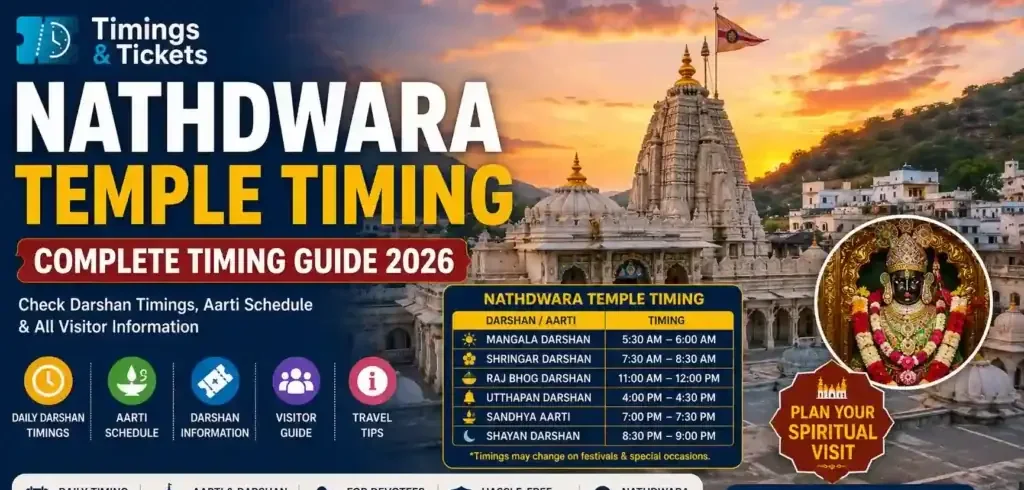
The names used in the Shrinathji daily darshan timetable can seem unfamiliar if you’re visiting for the first time. They represent different moments in the temple’s devotional routine. The exact clock times are not repeated here because the temple administration may revise them by date, season, festival or special instruction.
| Darshan or ritual period | What the name generally indicates | What visitors should verify |
|---|---|---|
| Mangal Darshan | Early worship and the first public viewing associated with the day’s beginning | Date-specific opening and entry time |
| Shringar Darshan | Darshan after the deity’s adornment or ceremonial preparation | Whether the public window and queue process have changed |
| Gwal Darshan | A later devotional viewing traditionally connected with the daily seva sequence | Current schedule and expected waiting period |
| Rajbhog Darshan | Darshan associated with the principal food offering of the day | Closing time before the offering and reopening information |
| Uthapan Darshan | An afternoon stage in the daily ritual cycle | Whether the window is operating normally on the selected date |
| Bhog Darshan | Darshan connected with a further offering period | Latest published aarti timings and entry instructions |
| Sandhya Aarti | Evening worship and devotional observance | Entry restrictions, crowd conditions and the day’s closing sequence |
| Shayan Darshan | The final evening viewing before the temple’s night closure | Final entry, queue cut-off and Nathdwara Temple closing time |
This table is a practical explanation of the commonly used categories, not a substitute for the official notice. Some visitors use “Pooja timing” and “Darshan timing” interchangeably, but they aren’t always identical. A ritual may continue inside while public entry is paused, and aarti timings may have separate arrangements from ordinary Darshan.
For that reason, write down the exact Darshan you hope to attend and verify its current opening and closing window. If your itinerary is flexible, choosing a less crowded period can be easier than trying to fit one narrow slot into a tightly packed day.
The Nathdwara darshan schedule is shaped by the temple’s ritual calendar. Daily routines provide a framework, but they don’t guarantee identical timings throughout the year. Festivals, important Vaishnav observances, seasonal arrangements, special decorations and administrative decisions can affect when the sanctum opens, how long Darshan remains available and how pilgrims are admitted.
Nathdwara festival timings deserve special attention. Events associated with Janmashtami, Annakuta, Holi, Diwali, Govardhan-related observances or other major temple occasions may draw much larger crowds and involve special seva arrangements.
The public may see a different sequence from the ordinary weekday timetable. Some periods can also include extended waiting, controlled entry or temporary restrictions intended to manage the crowd.
Sunday is another common search query. People often look for Nathdwara Sunday darshan timings because weekend travel is popular, but Sunday should not automatically be treated as a normal weekday. The correct approach is to compare the official date-specific notice with the regular daily darshan timetable and then plan conservatively.
The same principle applies to Nathdwara Temple holidays. A holiday for schools, offices or local businesses doesn’t necessarily mean that the temple is closed to devotees.
Conversely, a special temple observance can alter public Darshan even when the date isn’t a public holiday. Never infer the schedule from a general holiday calendar.
Queries such as “Nathdwara darshan today” and “tomorrow Nathdwara darshan timing” are useful starting points, but search snippets often display old pages or information without a visible update date. Use them to identify the question you need answered, not as final confirmation. A current notice, official booking screen or verified administration communication carries greater practical value.
If you’re already in Nathdwara, ask at an authorised information counter or follow the latest displayed notice near the temple approach. Avoid relying on an unverified message forwarded in a family or travel group, particularly during a festival.
The safest source is the Nathdwara Temple official website or the official booking and administration channel linked to it. Check whether the page shows the date of the notice, the applicable festival or the period for which the timings are valid. An attractive timetable image without a date may be several months old.
For an official reference point, consult the official Shrinathji Temple administration website and look for current Darshan, visitor, booking or notice information. If the website is temporarily unavailable, use verified temple administration announcements or contact information published by the temple itself rather than a random number from a social media post.
A reliable checking routine has several parts:
Information can also be displayed at local counters, but a counter’s guidance should be understood in context. The staff may be explaining a same-day operational change rather than publishing a permanent rule. Ask a precise question: “Which Darshan is open now, when is the next public entry, and is a pass required?” That is more useful than asking only for the temple’s closing time.
Darshan means viewing the deity in a devotional setting. It isn’t necessarily a long, seated ceremony for each visitor.
Depending on crowd management and the ritual period, the viewing may be brief and visitors may be guided through in a continuous flow. Shrinathji darshan duration therefore varies with the queue, the entry arrangement and the particular Darshan being offered.
Pooja refers more broadly to worship and offerings. Some visitors arrive expecting to participate in a private ritual, but not every Pooja is open to every pilgrim in the same manner.
Access may depend on the temple’s established arrangements, the type of seva, prior booking and current instructions. Don’t assume that a public Darshan pass includes a separate Pooja service.
Aarti timings also require care. Sandhya Aarti may be associated with a recognised evening devotional period, but the exact public viewing arrangement can differ from ordinary entry. If witnessing aarti is your priority, ask whether devotees can enter, where they should report, and whether the queue closes before the ritual starts.
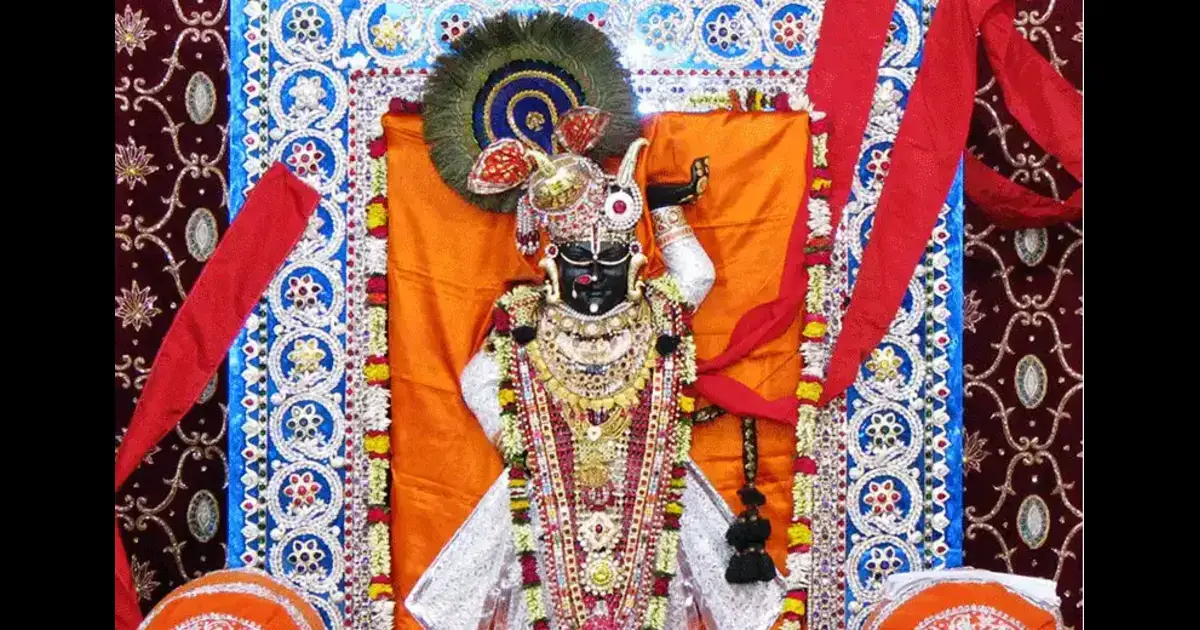
Shrinathji worship is closely associated with Pushti Marg, also known as the Vallabh Sampradaya. Understanding this helps explain why the temple routine is structured around seva, offerings, adornment and periods when the deity is not available for public viewing. Visitors don’t need specialist knowledge, but they should approach the schedule as a living religious practice rather than a sightseeing timetable.
Dress modestly, follow instructions from temple staff, and keep phones and personal belongings according to the current entry rules. Photography, bags, footwear and other restrictions may be controlled at the entrance. Since rules can change, check the latest instructions instead of relying on what another visitor experienced on an earlier trip.
The best visit is not always the one with the longest time inside. Arriving calmly, observing the queue and allowing the ritual to proceed respectfully will make the experience more comfortable for you and for other devotees.
Searches for VIP darshan and online darshan pass information are common because travellers want greater certainty about entry. The phrase “VIP Darshan” can mean different things in different temple systems, so you should not assume that a third-party package, hotel offer or agent’s promise represents an official temple facility.
Use only the booking route identified by the temple administration. Before paying, read the service name carefully, check the selected date and confirm whether the reservation is for Darshan, a specific seva, a donation-linked arrangement or another facility. A booking confirmation may have a reporting time that is earlier than the actual viewing period.
Some practical checks can prevent avoidable problems:
Online ticket reservations may open or close according to the temple’s operational capacity. A lack of online availability doesn’t automatically mean that the temple is closed, and an available form doesn’t guarantee immediate entry if the pilgrim arrives after the stated reporting window. Likewise, a Darshan booking does not remove the need to pass security or follow queue instructions.
If a website advertises VIP darshan at Nathdwara, compare its wording with the official temple information. Ask whether the service is issued by the temple, whether it includes a genuine entry pass, and what the reporting process is. Be particularly careful with social media accounts requesting advance transfers to personal bank accounts or promising access without any official receipt.
For families, older visitors and people with mobility needs, the most helpful arrangement may be clear reporting guidance rather than a vague promise of priority. Contact the official administration before travel and ask what assistance is currently available. Policies are operational and may change.
Plan backwards from the Darshan reporting or entry time, not from the time you hope to reach the town. You’ll need time for parking or local transport, walking through busy streets, security checks, footwear arrangements and locating the correct queue. On festival days, the approach roads and market area may take longer to cross than expected.
Visitors commonly search for the Nathdwara to Shrinathji Temple distance, but the answer depends on the point from which you measure. Nathdwara is the temple town itself, and the practical issue is often the distance from your hotel, bus drop-off, parking area or approach road to the permitted entrance. Ask your accommodation for current local access advice instead of relying on a map pin alone.
Those searching for Nathdwara Temple Udaipur information should separate the journey from Udaipur from the final walk inside Nathdwara. Travel time between the two places varies with road conditions, vehicle type and traffic. If your plan is a same-day return, avoid scheduling the last Darshan so close to your departure that a queue delay could disrupt the journey.
There is no universal buffer that works for every date. A normal weekday, a Sunday, and a major festival can create very different conditions. Keep extra time for a peak day, and confirm whether your booking requires you to report before the listed Darshan period.
If you’re travelling with children or elderly relatives, carry water and essential medicines in accordance with the current entry rules. Don’t bring unnecessary bags. Smaller belongings generally make security and queue movement easier, subject to the temple’s specific policy.
Accommodation near the temple can be convenient, but proximity alone doesn’t guarantee quick entry. Streets may be crowded, and the access route for one hotel may not match the route shown on a general map. Get directions from the hotel staff on the morning of your visit and cross-check them with official instructions.
A little preparation reduces uncertainty without turning a devotional visit into a complicated project. The following process works for visitors checking Darshan, Pooja or booking arrangements.
This method also helps when you’re asking about Nathdwara darshan today from inside the town. You can identify the next available period, verify whether a pass is necessary, and avoid standing in the wrong queue based on a visitor’s guess.
One of the most frequent mistakes is treating an old timetable as permanent. Temple schedules are often copied across travel pages, social posts and hotel listings without the date or notice that originally accompanied them. A timetable may correctly describe a general routine yet still be wrong for the day you’ve selected.
Another mistake is confusing temple opening hours with continuous public access. The gate may open for one ritual and close before the next. Likewise, reaching the temple before the final closing time may not help if entry to that Darshan has already stopped.
Visitors also sometimes book accommodation or transport before confirming the desired ritual. If Rajbhog Darshan is important to you, build the day around its published window and allow for crowd movement. If the visit is simply for general Darshan, keep more flexibility and avoid an unnecessarily tight itinerary.
There’s also a simple communication mistake: asking only, “When does the temple open?” A more useful question is, “Which public Darshan is available at that time, when does entry close, and is a booking required?” This wording reflects the way the temple actually operates.
Source-based example: The official Shrinathji Temple administration website presents the temple day through named Darshan and seva periods rather than one uninterrupted visitor window. The sequence includes recognised categories such as Mangal, Shringar, Gwal, Rajbhog, Uthapan, Bhog, Sandhya Aarti and Shayan Darshan. That is the verified point relevant to planning: public viewing is connected with ritual stages, and the current date-specific schedule must be checked before travel.
The example does not establish fixed clock times for every day. Those times may be revised through official notices, particularly around festivals or special observances. It would therefore be misleading to turn the general sequence into a permanent list of exact hours.
For a practical scenario, imagine a family staying in Nathdwara and hoping to attend Rajbhog Darshan. The responsible plan is to check the official date notice, confirm the reporting requirement, reach the approach area early, and keep the afternoon open in case the queue takes longer than expected.
The family should not rely on a hotel poster or a timetable copied from an undated travel page. This is an illustrative planning example, not a claim about a particular family or date.
The broader lesson is useful for every pilgrim: a temple schedule has both a ritual dimension and an operational dimension. The first explains the Darshan name; the second determines public access on your chosen day.
The temple follows several named Darshan periods across the day, including Mangal, Shringar, Gwal, Rajbhog, Uthapan, Bhog, Sandhya Aarti and Shayan. Exact clock timings can change, so verify the current daily timetable through the official temple administration before travelling.
There may be more than one opening period because the temple can close between ritual stages. Check the first public Darshan listed for your date rather than relying on a single general opening-hour claim.
The final public viewing is associated with the day’s closing sequence, but the effective last-entry time may be earlier than the final closure. Confirm Shayan Darshan, queue cut-off and final entry instructions for the date of your visit.
Shrinathji darshan duration depends on the queue, crowd level, entry system and ritual period. The viewing itself may be brief, but the total visit can take longer because of walking, security and waiting.
Check whether the official administration currently offers the category and use only its authorised booking route. Confirm what the pass includes, the reporting time and the identification requirements. Avoid unofficial agents promising guaranteed entry.
Not necessarily. Requirements can differ by Darshan, date and administrative arrangement. Read the current official notice instead of assuming that a pass is always required or never required.
The best time depends on your priority. A pilgrim focused on a particular Darshan should plan around that ritual, while someone seeking a less pressured visit may prefer a non-festival date with more schedule flexibility. Check current crowd and entry information before deciding.
A successful visit to Shrinathji Temple begins with treating the timetable as a live religious schedule, not a permanent tourist-hours chart. Check the latest Nathdwara temple timing, match it to your preferred Darshan or Pooja, confirm booking and entry requirements, and allow extra time for queues and local travel.
Before leaving home, verify the official notice once more—especially if you’re visiting on Sunday, a festival date or a special occasion. A few minutes spent checking the current schedule can protect the Darshan you’ve planned for and help you arrive with the calm, respectful mindset the visit deserves.





