Physical Address
304 North Cardinal St.
Dorchester Center, MA 02124
Physical Address
304 North Cardinal St.
Dorchester Center, MA 02124
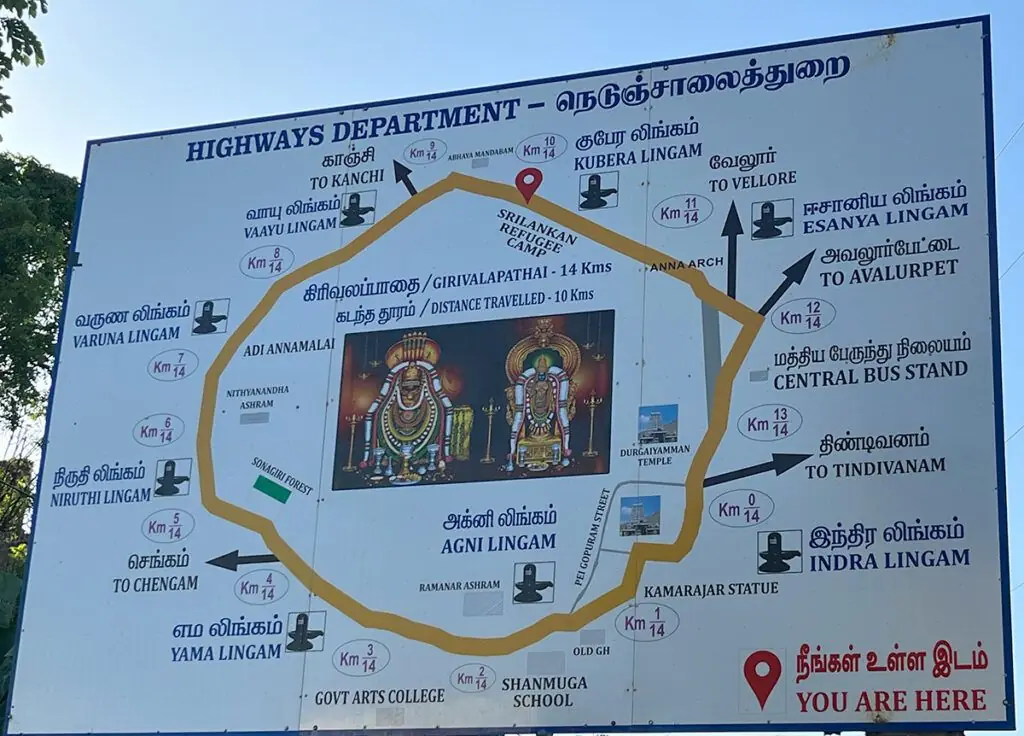
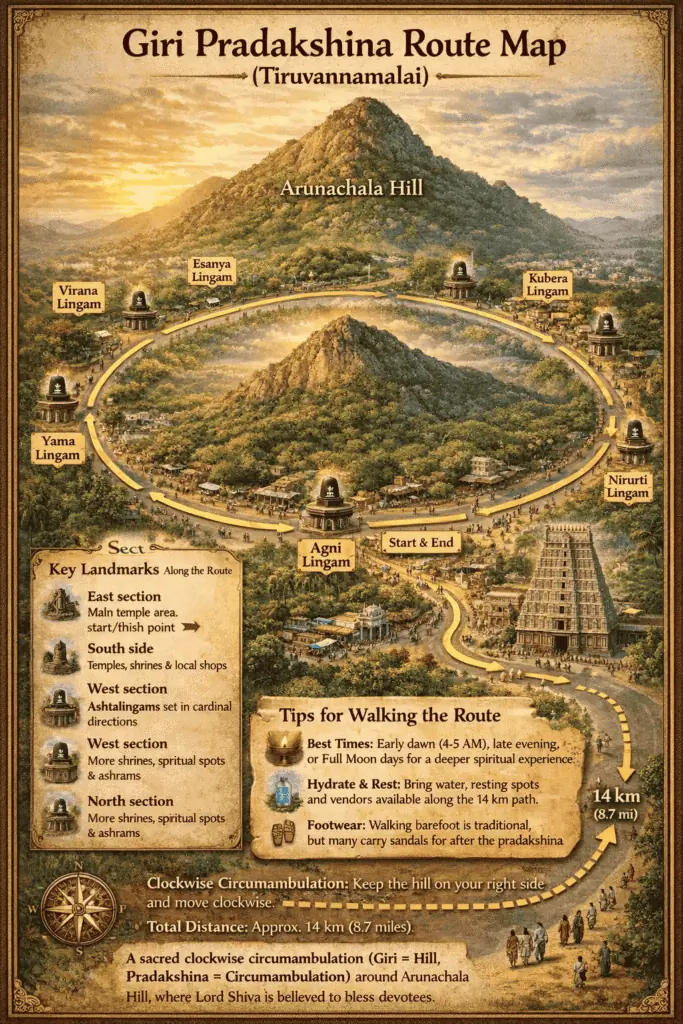
The Arunachalam Temple Giri Pradakshina distance is commonly understood as roughly 14 kilometres around Arunachala Hill, though the exact walking line can vary with diversions, road conditions and the point where you start. That distance matters because your walking time, Darshan plan, Pooja attendance and rest breaks all depend on it.
You’ll also need current information on temple opening hours, festival crowds, entry rules and any available booking arrangements. This article explains the route, realistic time planning and the safest way to verify official schedules before travelling to Tiruvannamalai.
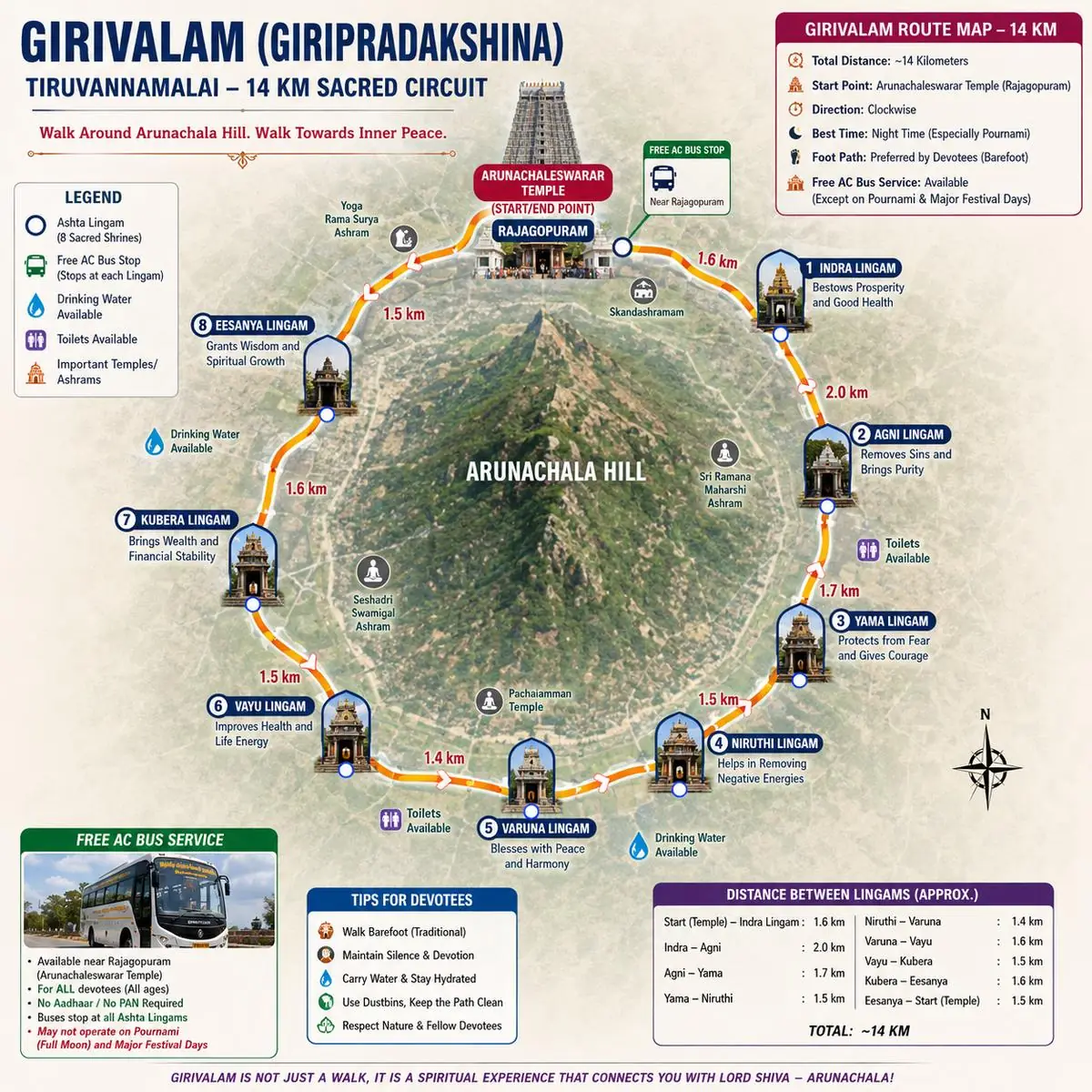
Giri Pradakshina, also written as Girivalam, is the traditional circumambulation of Arunachala Hill in Tiruvannamalai, Tamil Nadu. The widely cited walking distance is about 14 kilometres, but it should be treated as an approximate route distance rather than a guaranteed measurement from every starting point. Small changes in the road, barricades, temporary diversions and your chosen approach can alter the total.
The route generally follows the public road around the sacred hill rather than a narrow mountain trail. This is important for first-time visitors: Giri Pradakshina is not the same as climbing Arunachala Hill. You walk around the hill, usually on the designated roadside or pedestrian sections, and pass important shrines and landmarks connected with the circuit.
Many pilgrims begin near Arunachaleswarar Temple, the main Shiva temple in Tiruvannamalai. Others start at a hotel, ashram, bus stand, railway station or another point along the circuit. If you begin away from the temple, the distance shown by a mobile map may include the approach walk as well as the actual hill circuit.
The number “14 kilometres” is therefore useful for planning, not for measuring every person’s exact experience. A person walking continuously at a steady pace may finish faster than someone who stops at shrines, rests frequently, visits the main temple or joins a crowded festival procession. Your footwear, weather, age, health and spiritual practice all affect the time.
| Planning point | Practical meaning | What you should verify |
|---|---|---|
| Commonly cited circuit | About 14 km around Arunachala Hill | Current route diversions and local directions |
| Starting point | Often near Arunachaleswarar Temple, but not compulsory | Whether your accommodation adds extra walking |
| Walking time | Varies according to pace, stops, crowds and weather | Festival restrictions and road conditions |
| Temple visit | Separate from completing the hill circuit | Darshan, Pooja and entry schedules |
Do not confuse the hill circuit with the inner pathways or temple circumambulation areas inside Arunachaleswarar Temple. Those are separate parts of a visit. If your plan includes both the main temple Darshan and Giri Pradakshina, allow enough time for queues and movement between locations.
The most practical starting point for many pilgrims is the area around Arunachaleswarar Temple, also known as Annamalaiyar Temple. From there, you can join the outer circuit and follow the road around Arunachala. The route is familiar to local residents and auto-rickshaw drivers, but first-time visitors should still confirm the direction before setting out, especially at night or during a major festival.
A route map can help you identify the main road, rest points, nearby facilities and the approximate position of the eight directional lingams traditionally associated with the circuit. These include Indra Lingam, Agni Lingam, Yama Lingam, Niruthi Lingam, Varuna Lingam, Vayu Lingam, Kubera Lingam and Esanya Lingam. Local signboards and temple information boards may use Tamil spellings or alternate English transliterations.
Sri Ramanasramam is another well-known landmark on the Tiruvannamalai circuit. Depending on where you begin, it may be near your route or may require a short approach walk. Other visitors use their accommodation as the starting point, particularly if they want to complete the circuit early and return for bathing, breakfast or temple Darshan later.
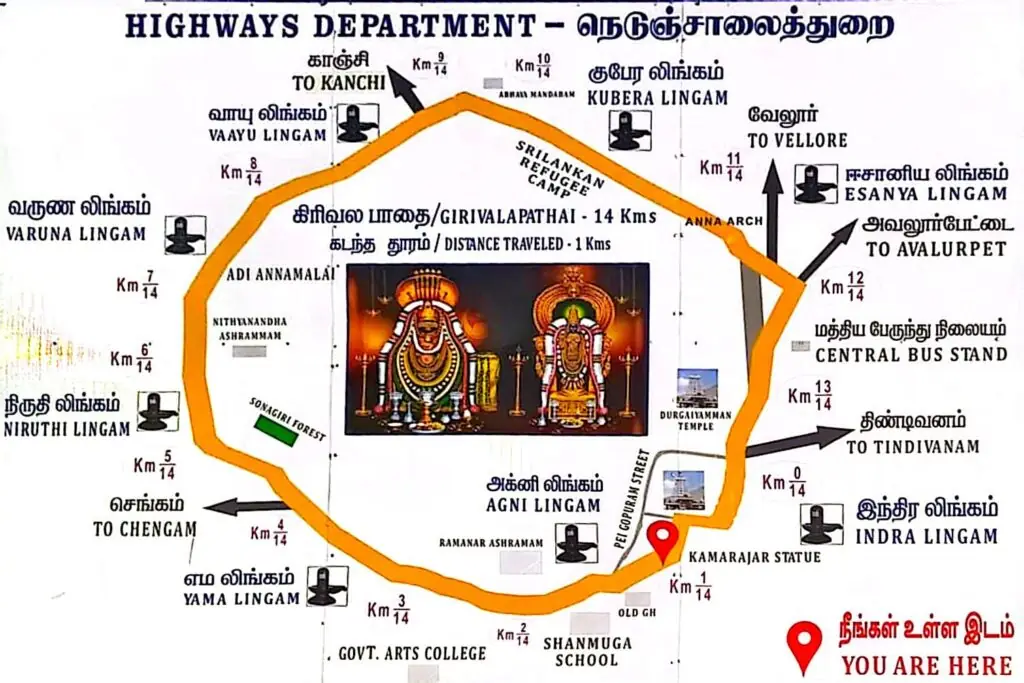
The outer road can be busy, and walking conditions change with traffic, lighting and crowd movement. A mobile map may show a shorter line that is not suitable for pilgrims because it cuts through local roads or private areas. Use it as a reference, not as a substitute for signs, police instructions or local temple administration guidance.
Some devotees prefer to walk barefoot as an act of devotion. That is a personal religious choice, not a requirement that should be assumed for every visitor. If you’re not accustomed to barefoot walking on hot or rough surfaces, plan carefully and protect your feet in a way that respects your health and your own practice.
There is no single official completion time for Giri Pradakshina. A continuous walk may take several hours, while a devotional walk with shrine visits, prayer, rest and food breaks can take substantially longer. The question “How many hours does it take?” is best answered by separating walking time from the full pilgrimage experience.
| Walking style | Likely planning approach | Important caution |
|---|---|---|
| Steady, uninterrupted walk | Plan for several hours, depending on individual pace | Do not assume the fastest possible pace is suitable for you |
| Moderate devotional walk | Allow extra time for prayer, water and rest | Crowds may slow progress considerably |
| Family or senior-pilgrim visit | Build in frequent pauses and access to transport | Heat, fatigue and uneven surfaces need attention |
| Full-moon or festival period | Keep your schedule flexible rather than fixed to a finish time | Traffic controls and queues can change the route |
Walking speed is only one factor. A person who walks quickly but stops often may take longer than someone moving at a moderate pace without extended breaks. Crowds can also make a major difference, particularly on Pournami, which is the full-moon day, and during significant temple festivals.
If you’re travelling with children, older adults or anyone with a medical condition, don’t plan the circuit around an aggressive timetable. Choose an early start when weather conditions are more comfortable, identify points where transport may be available and keep essential medicines with you. A shorter planned visit is better than forcing someone to complete a walk beyond their ability.
The route may be active at night, but darkness creates practical concerns. Visibility, vehicle movement, tiredness and difficulty locating a specific facility can all become problems. Ask the local temple administration, police personnel or accommodation staff about the current conditions before choosing a late-night start.
Giri Pradakshina is not the same as a temple Darshan slot with one fixed daily entry time. Pilgrims walk the public circuit at different hours, subject to local conditions, traffic arrangements and any restrictions announced for a festival or major event. A timing that works on an ordinary weekday may not work on a crowded full-moon night.
Many visitors prefer the early morning because the road and weather may be more manageable than later in the day. Others begin in the evening or at night because their religious practice or travel schedule suits that period. Neither choice removes the need to check current local instructions.
The question of starting at 1 am needs a careful answer. A late-night start may be possible in some circumstances, but readers should not treat general online advice as permission or as confirmation that every section will be convenient and safe. Check the latest instruction from local authorities, the temple administration and your accommodation before leaving at that hour.
On ordinary days, a flexible schedule is usually more useful than a minute-by-minute plan. On festival days, flexibility becomes essential. Roads may be crowded, vehicles may be redirected and temple queues may extend beyond the time you expected.
Arunachaleswarar Temple has its own Darshan, Pooja, Aarti and temple opening-hour schedule. These timings should not be assumed to match the time available for Giri Pradakshina. A pilgrim can complete the hill circuit while the main temple is temporarily closed for a ritual interval, or arrive at the temple during a busy Darshan queue.
Temple schedules can change for daily rituals, special observances, festival days, maintenance, crowd management or administrative reasons. Exact timings, paid services and entry arrangements should therefore be checked through the official temple administration or its recognised booking channel shortly before travel.
Darshan generally refers to viewing and offering prayers to the deity. It may be available through a general queue, a special queue or a ticketed arrangement, depending on the temple’s current system. A ticket, where offered, may reduce waiting in a designated line but doesn’t automatically guarantee immediate entry during exceptional crowd conditions.
Pooja means a ritual offering or worship service. Some Pooja services may be open for public participation, while others are conducted by temple priests according to the daily schedule. The name, timing, fee and booking procedure can vary, so don’t rely on an old social-media post or an unofficial agent.
Aarti is a ritual involving the offering of light. The timing may be connected to the temple’s daily worship sequence and can change on special days. If attending a particular ritual is central to your visit, reach the temple area early and ask the authorised enquiry counter about queue entry and seating or viewing arrangements.
Temple opening hours also don’t necessarily mean that every shrine, counter or Pooja booking desk operates continuously throughout the day. You may find separate timings for general entry, special Darshan, accommodation offices, prasadam counters and ritual registration.
Not every temple visit requires online booking, and not every Pooja service is available through the same portal. Some arrangements may be handled at an official counter, while others may be listed on a government or temple-managed website. The correct process depends on the service you want: general Darshan, a special entry ticket, a Pooja, accommodation or another temple facility.
Before paying, identify the official source. The safest signs include a government or temple administration domain, clear contact information, an official notice, and a payment page that matches the service you selected. Be cautious with agents who promise guaranteed Darshan, instant access or special treatment without a verifiable receipt.
Keep a digital copy and, if practical, a printed copy of your confirmation. Carry the identity document used during booking if the official instructions require it. You should also read restrictions on cameras, bags, mobile phones, dress, food and personal items before reaching the entry gate.
Online booking does not remove the need to arrive at the stated reporting time. A ticket may be valid only for a particular service window, and late arrival may be handled according to the temple’s current policy. Never assume that a payment made to an unofficial website creates a valid temple reservation.
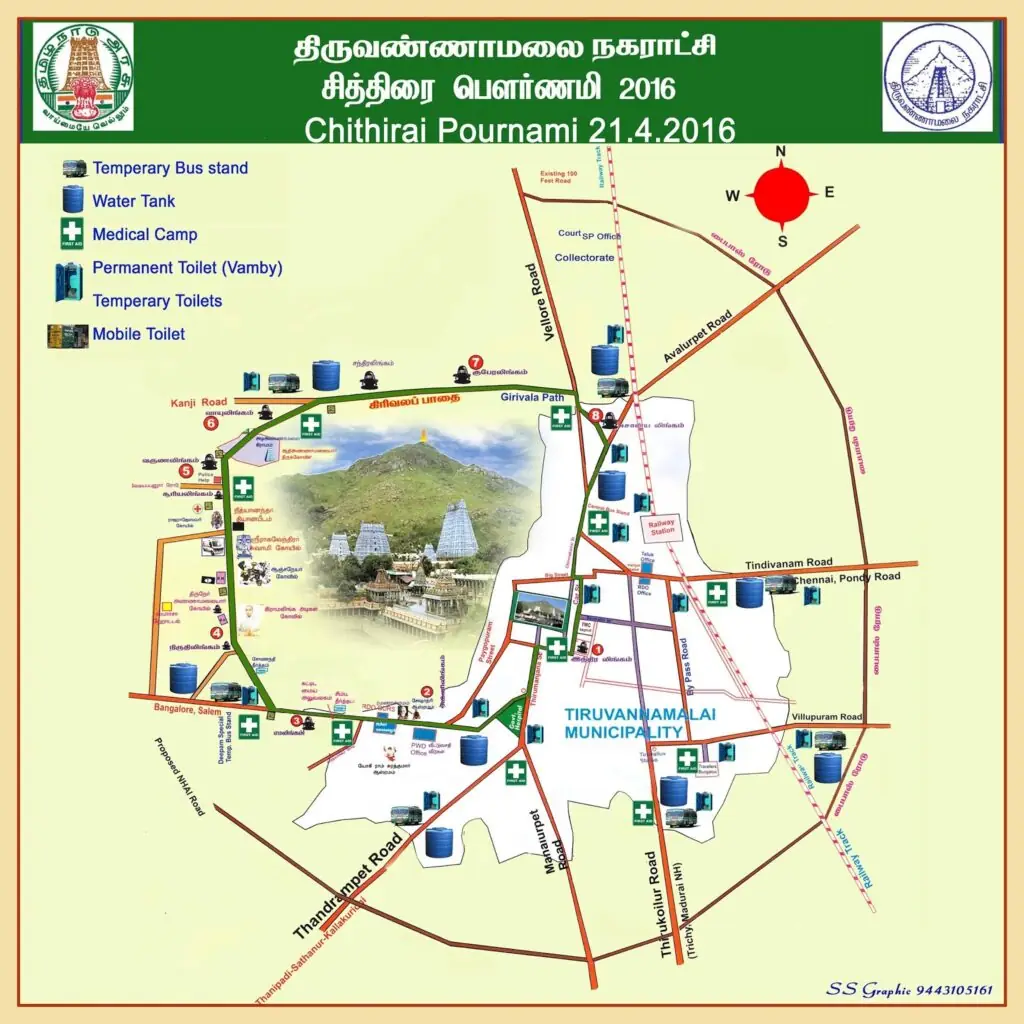
The Arunachala region can become especially busy during Pournami, major Shaivite observances and important temple festivals. The crowd experience on a peak day may be very different from a normal weekday. The Giri Pradakshina distance remains broadly the same, but your walking time, queue time and access to the main road can change significantly.
Karthigai Deepam is one of the most important occasions associated with Tiruvannamalai and Arunachala. Because arrangements can involve large crowds, traffic controls, security measures and special event schedules, visitors should depend on current official announcements rather than a previous year’s itinerary. The exact operating plan can change from one year to the next.
Peak-day planning should begin with accommodation and transport. Rooms may become difficult to obtain, and vehicles may not be able to reach the same point as on an ordinary day. If you’re staying near Sri Ramanasramam, the temple, the bus stand or another local landmark, ask the property staff about pedestrian access and the nearest permitted vehicle drop-off point.
Do not build a tight onward-travel plan immediately after Giri Pradakshina on a major festival day. Delays can occur without warning, especially when thousands of people are moving along the same road. A flexible bus, train or hotel schedule will make the pilgrimage less stressful.
A useful real-world example is the official Hindu Religious and Charitable Endowments administration portal for Tamil Nadu, which is used to publish information for temples under the state’s administration. The Arulmigu Arunachaleswarar Temple’s official listing and administration channels are the appropriate starting points for checking current notices, temple services and contact details. You can consult the official Arulmigu Arunachaleswarar Temple information portal before finalising a visit.
The verified fact here is that an official administration channel exists and should take priority over unofficial booking pages. This does not mean that every online search result is official, nor does it mean that a page viewed today will contain every temporary traffic or festival instruction. General guidance in this article—such as allowing extra time in crowds, confirming route diversions and checking the service name before payment—is practical planning advice rather than a claimed temple rule.
Readers should distinguish three types of information. First, there are relatively stable reference details, such as the association of Tiruvannamalai with Arunachala and the commonly cited approximate circuit distance.
Second, there are changing operational details, such as Darshan timing, Pooja booking availability, entry rules and road restrictions. Third, there are personal planning choices, including whether to walk barefoot, begin early or take breaks.
When an official website and an old blog disagree, use the current official notice or contact the temple administration. If the website is temporarily unavailable, ask your hotel, ashram or local information desk to help you identify the authorised channel rather than relying on a forwarded message.
A simple sequence can prevent many avoidable problems. Start by deciding whether your priority is the hill circuit, main temple Darshan, a specific Pooja or all three. The answer affects how much time you need and whether you should walk before or after visiting Arunachaleswarar Temple.
If you’ve booked a Pooja, confirm whether the booking is for participation, an offering made on your behalf or entry to a designated area. Those are not always the same thing. Ask the authorised counter if the receipt doesn’t clearly explain what the service includes.
After completing the walk, you may still face a temple queue. Finishing Giri Pradakshina does not automatically provide priority Darshan unless the official temple system specifically says so. Keep your booking receipt and follow the instructions given at the entrance.
The most common mistake is treating an approximate distance as a precise promise of completion time. A 14-kilometre walk can feel very different in hot weather, on a crowded road or after a long train journey. Plan around your own capacity rather than a stranger’s fastest reported timing.
Another error is combining several fixed appointments too closely. A traveller may book an early Pooja, schedule Giri Pradakshina immediately afterwards and reserve a return bus with no margin.
Queues, road diversions and rest needs can disrupt that plan. Keep at least some breathing room between major activities.
Some visitors also underestimate the importance of footwear and hydration. Comfortable walking shoes can prevent blisters, while a light bag is easier to carry than a large suitcase. If your religious practice involves barefoot walking, inspect the surface and take appropriate precautions rather than copying another pilgrim’s routine.
The commonly cited distance around Arunachala Hill is approximately 14 kilometres. Your actual walk may be longer or shorter depending on your starting point, diversions and approach route.
It varies by pace, crowd conditions, stops and weather. A continuous walk takes several hours for many people, while a devotional walk with prayer and rest can take longer. Plan conservatively.
Do not assume that a 1 am start is always permitted, comfortable or safe along every section. Check current instructions from the local administration, temple channels and your accommodation before starting at that hour.
No. Giri Pradakshina is the circumambulation of Arunachala Hill. Visiting Arunachaleswarar Temple involves a separate Darshan and temple-entry process, with its own timings and queues.
Requirements can vary by service and date. General entry, special Darshan and Pooja participation may follow different procedures. Check the current official temple information before paying or travelling.
Carry water, essential medication, a charged phone, identification, light clothing and suitable walking support. Avoid unnecessary valuables and follow temple rules about bags, cameras and personal items.
The Arunachalam Temple Giri Pradakshina distance is best treated as an approximate 14-kilometre sacred circuit, not as a fixed appointment with a guaranteed finish time. Your actual experience depends on the starting point, walking pace, road conditions, weather, queues and festival arrangements. Keep Giri Pradakshina, temple Darshan and Pooja bookings as related but separate parts of your itinerary.
Before you travel, verify the latest official schedule, booking instructions, entry rules and route notices. Then leave enough time to walk safely, pray without rushing and adapt if local conditions change. A little careful checking before departure can make your visit to Arunachala more peaceful and practical.





