Physical Address
304 North Cardinal St.
Dorchester Center, MA 02124
Physical Address
304 North Cardinal St.
Dorchester Center, MA 02124

A Pandharpur darshan pass can make a visit to the Shri <strong>Vitthal Rukmini Temple more predictable, especially on Ekadashi, weekends and major festivals. The pass system, queue arrangements, and availability may change according to crowd levels and instructions from the temple administration, so relying on old social-media posts can create confusion.
Before travelling to Maharashtra’s Pandharpur, check the latest information from the official temple trust or authorised booking channel. You’ll find practical guidance here on darshan schedules, pooja timings, online and offline booking, documents, entry rules, festival variations and planning a respectful visit to Lord Vitthal and Rukmini Devi.
The most important point is simple: a pass doesn’t always mean the same thing as guaranteed immediate entry. It may refer to a scheduled darshan ticket, a priority or special-darshan facility, or a token issued for crowd management. Confirm what your selected booking actually includes before paying or travelling.
A Pandharpur darshan pass is an authorisation, ticket, token or time-related booking used to help devotees enter the darshan system at the Vitthal Rukmini Temple. “Darshan” means respectfully seeing and worshipping the deity. At busy times, the temple administration may regulate queues through passes, tokens, barricaded lines or designated entry slots.
In everyday conversation, devotees may use several terms interchangeably:
These labels don’t establish a permanent temple policy. The Shri Vitthal–Rukmini Mandir administration may alter arrangements for security, festivals, crowd control, maintenance or government instructions. A pass could also have a reporting time rather than a guaranteed minute of darshan.
The Vitthal Rukmini temple follows a daily worship routine that includes opening rituals, darshan periods, naivedya, aarti and night closure. The exact timetable can be revised, and public access may not match the time of an internal ritual. For this reason, devotees should distinguish between pooja timing and visitor entry timing.
Temple schedules are particularly sensitive during Ashadhi Ekadashi, Kartiki Ekadashi, Maghi Ekadashi, Chaitra Ekadashi and other high-footfall periods. The temple may manage access in phases, restrict queues, pause entry during rituals or introduce special arrangements for pilgrims arriving with dindis.
| What you want to know | Why it matters | What to verify before leaving |
|---|---|---|
| Temple opening time | The first public entry may differ from the first morning ritual. | Official daily schedule and gate instructions |
| Darshan availability | Darshan may pause during rituals, crowd surges or security checks. | Whether your pass has a reporting slot or queue number |
| Pooja and aarti timings | Some worship services are conducted for the deities and aren’t automatically open for public participation. | Whether devotees may attend, view or book the service |
| Temple closing time | Last entry can be earlier than the final closing ritual. | Last permitted entry and expected queue cut-off |
| Festival-day schedule | Normal timings may be suspended or replaced by special crowd plans. | Festival notice, district advisory and temple announcement |

A temple’s “opening time” may refer to the opening of the premises, the beginning of a ritual, or the start of general darshan. These are not necessarily identical. Likewise, a closing time may mean the final gate closure, the end of ordinary darshan, or the completion of the night worship routine.
For a reliable answer, use the official schedule published by the temple trust or ask the authorised enquiry counter. The temple’s official website, notices at the premises and verified administrative announcements should take priority over travel websites, forwarded messages and old videos. The official Shri Vitthal Rukmini Temple information portal is a useful starting point, but check that the page or notice is current for your travel date.

Daily worship may include morning rituals, offerings, naivedya, aarti and the night ceremony. Terms such as naivedya refer to food offered to the deity, while aarti is a devotional lamp ceremony. A pooja booking, where available, is different from ordinary darshan because it may relate to participation in or sponsorship of a specific religious service.
Don’t assume that buying a pooja facility gives access to every part of the shrine or permits photography. Ask whether the booking is for a devotee, a family group, a representative offering, or a particular ritual. Rules can also differ between the main Vitthal shrine and the nearby Rukmini Mandir.
There is no single permanent booking window that applies to every date, pass category or festival. The booking opening time may depend on the portal, the temple trust, the number of available slots and the schedule approved for that season. Some facilities may be released days in advance, while others may be issued closer to the visit or only at the temple.
For a 2026 visit, don’t assume that a booking pattern from 2024 or 2025 will continue. Search for the current notice on the official temple channel and confirm the calendar year, date, reporting time, number of devotees allowed and payment status before finalising travel.
A genuine portal should explain the transaction and confirmation process clearly. Be cautious if a social-media contact promises guaranteed VIP access, asks for payment to a personal account or refuses to provide an official receipt.
If online booking is open, the process usually involves selecting a service, entering devotee details, choosing a date and making payment. The exact screen names and requirements can change, so treat the following as a practical sequence rather than a fixed temple rule.
Use a stable internet connection and avoid refreshing the page repeatedly during payment. If money is debited but confirmation doesn’t appear, first check your email, SMS, booking dashboard and bank statement. Don’t immediately pay again; contact the portal’s official support channel with the transaction reference.
Requirements vary by service. A booking may ask for the devotee’s full name, mobile number, age, address, identity details and number of visitors. The accepted identity document and whether the original must be shown at entry should be confirmed on the booking page.
Carry the document used during booking if the rules require identity verification. A screenshot alone may not be sufficient if the pass includes a QR code that needs to be scanned from the original confirmation or if staff request a physical identity document. Never upload unnecessary sensitive information to an unofficial form.
Offline arrangements are useful for devotees who don’t have reliable internet access or who decide to visit after arriving in town. They’re also subject to availability. A counter may issue tokens only for the same day, may stop distribution once capacity is reached, or may be closed during a festival crowd-control operation.
Ask the temple administration or an authorised information desk where the current counter is located. Don’t rely on auto-rickshaw drivers, hotel staff or unauthorised touts as the final authority on pass availability. They may offer useful local directions, but the booking rule must come from the temple or its official notice.
At an offline counter, check the printed pass before leaving. Confirm the devotee count, date, service type, reporting time and any identity requirement. If something is incorrect, request correction immediately rather than discovering the problem at the entrance.

Ordinary darshan generally means joining the regular devotee queue. Special darshan, if offered, may use a separate line or a controlled entry arrangement. “VIP darshan” is widely searched online, but the phrase doesn’t by itself prove that a particular seller, price or privilege is officially recognised.
Ask three questions before making payment: Who issued the pass? What service does it actually provide? Where and when must the holder report?
A legitimate special facility may still involve waiting, security checks and crowd restrictions. It shouldn’t be described as permission to bypass every rule.
Priority facilities can also be withdrawn or adjusted during major religious gatherings. Temple security, police instructions and district administration orders can take precedence over a previously advertised arrangement. Devotees should retain a flexible travel plan, particularly during Ashadhi and Kartiki Ekadashi.
Pandharpur is closely associated with the worship of Vitthal, a form of Lord Vishnu revered in the Varkari tradition. The town receives large pilgrim gatherings during the Ashadhi and Kartiki Ekadashi periods, when palkhi processions and dindi groups add a major religious and logistical dimension to the visit.
On such dates, ordinary temple routines may be changed. Roads can be diverted, accommodation can become scarce, mobile networks may be congested and entry arrangements may be announced through temporary counters or designated holding areas. A pass that works on a normal weekday may not apply during the festival period.

Start by checking the festival calendar and the temple’s current announcement. Then confirm transport, lodging and the last practical time at which you must report. Don’t schedule a tightly timed return journey immediately after darshan; queues and traffic management can be unpredictable.
Devotees travelling in a group should nominate one person to hold the booking details and another to manage children or elderly members. Keep water, essential medicines and a simple meeting point in case the group separates. Follow police and temple volunteers, even if an informal shortcut appears faster.
Entry normally involves approaching the designated gate, showing the pass or booking confirmation when requested, completing security screening and joining the assigned queue. The exact path can change because of crowd management, construction, festival barricades or administrative instructions.
Keep your phone charged and store the pass where it can be shown quickly. Staff may ask to see the original identity document, the booking reference or the names of people included in the reservation. A pass issued to one person shouldn’t be assumed to be transferable.
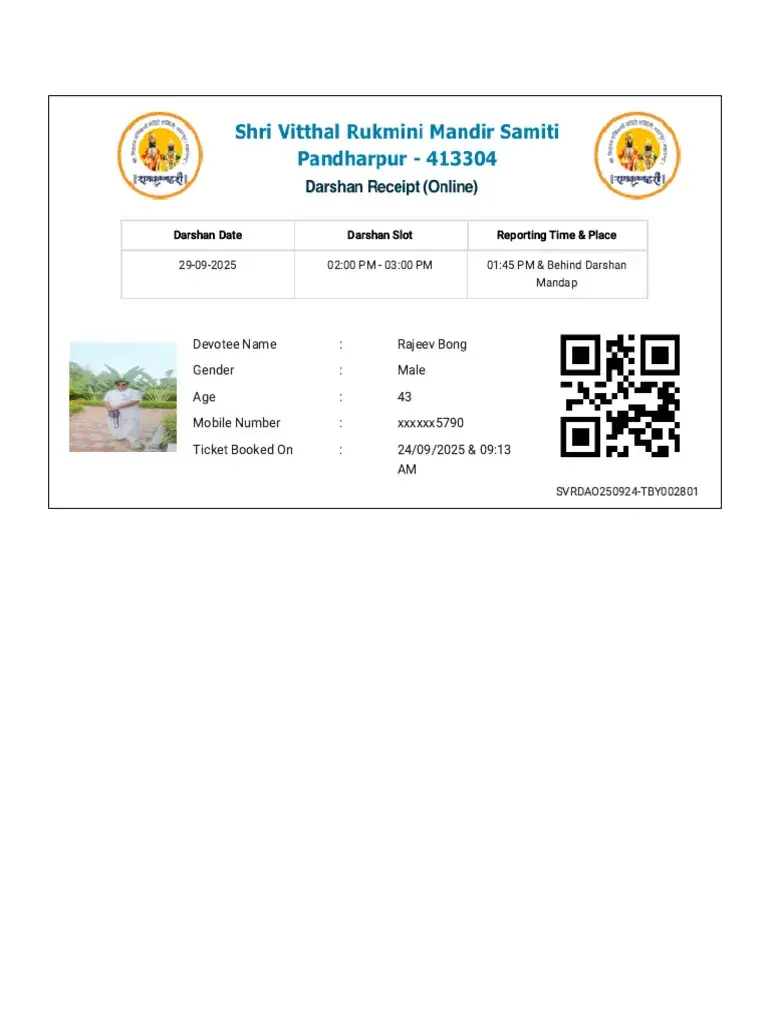
Temple rules about mobile phones, cameras, bags, prasad and offerings can change. Carry only what you need. If lockers or cloakrooms are available, use an authorised facility and retain the receipt.
Modest, comfortable clothing is a sensible choice for a temple visit. The shrine may issue specific instructions about dress, footwear or items carried inside. These rules are part of maintaining the sanctity and safety of the premises, not merely formalities.
Don’t push through a queue, offer money to staff for an unofficial shortcut or photograph restricted areas. Avoid touching the deity, railings or ritual objects unless the temple explicitly permits it. Darshan is brief for many visitors, so prepare mentally for a short, respectful moment rather than expecting a prolonged viewing.
Vitthal and Rukmini worship is meaningful to devotees from Maharashtra and many other parts of India. Visitors unfamiliar with the Varkari tradition can observe quietly, follow the instructions of priests and volunteers, and ask questions politely at an information counter.
Pandharpur can be reached by road and rail, with travel conditions varying by season and festival traffic. Your best arrival time depends on the pass reporting slot, the distance from your hotel and the likely security queue. Reaching just before the printed time is risky, particularly if you need to park, collect an offline token or walk to the gate.
For a normal-day booking, build a practical buffer around the reporting time. During a major pilgrimage, plan for much more uncertainty. Accommodation near the temple may fill quickly, while budget options and trust-managed lodging may have their own check-in rules.
If you’re visiting both the main Vitthal shrine and the Rukmini temple, check whether each has separate access instructions. The terms “Vitthal Rukmini,” “Rukmini Mandir” and “Rukmini temple” are often used in travel searches, but the pass you book may cover only one specified service or location.
Cancellation and rescheduling rules are service-specific. Some religious bookings may be non-refundable, while others may permit changes only before a stated deadline. A convenience charge or donation component might also be treated differently from the base booking amount.
Read the terms before payment and save a copy of the confirmation page. If the temple changes the schedule, follow the official process described in its notice rather than accepting an informal promise from an intermediary.

If your plans change, don’t assume another family member can use your pass. Ask the issuing authority whether transfer, name correction or rescheduling is permitted. Entry staff generally follow the details printed in the official record.
Example only, not a verified temple schedule: Imagine a family of four from Pune planning a weekday visit outside a major festival. They first select an available online darshan slot, then compare it with their train arrival and hotel check-in time. Instead of booking a return journey immediately after the expected darshan, they leave several hours of flexibility.
Before travelling, the family saves the booking confirmation, carries the identity documents mentioned by the portal and checks the official temple notice again. At Pandharpur, they follow the gate printed on the pass, ask staff whether the Rukmini temple requires separate arrangements, and keep bags and prohibited items outside the shrine if instructed.
This example illustrates sound planning, not a promise that the same slot, rule or entry route will be available. The administration’s current announcement always takes priority.
Many problems arise because devotees treat a search result as an official notice. A video may show an old queue system, and a booking agent may use the words “VIP pass” without explaining who authorised the service.
A little verification prevents most avoidable trouble. If information conflicts, contact the temple administration directly and record the answer, including the date on which you received it.
Use a simple source hierarchy. The official temple trust or administration comes first, followed by an authorised booking portal, a current notice at the temple and verified government or district announcements. Travel blogs and social posts can help with general planning, but they shouldn’t be used to confirm a price, pass category or time-sensitive entry rule.
Check the date of every notice. “Open now” search results may describe an old booking cycle, and a page may remain online after a festival arrangement has ended. Look for the temple name, official contact details, terms of service, refund information and a proper receipt.
Exact prices also require verification. The cost of a Pandharpur darshan pass may depend on the category, service, donation, booking channel and current temple policy. Rather than quoting an unverified amount, confirm the total displayed at the official payment stage and keep the receipt.
Check the current official temple trust or authorised booking portal for online availability. If online booking isn’t offered for your date, ask the temple administration about authorised offline counters and same-day tokens. Carry the required identity document and don’t pay unofficial agents who promise guaranteed entry.
Special or priority darshan may be available at certain times, but it isn’t a permanent guarantee. Availability, eligibility, price, reporting location and queue arrangements can change, especially during festivals. Confirm the facility directly through the current official notice before making travel arrangements.
Use the official booking channel when the 2026 calendar and slots are released. Select the correct service and date, read the entry conditions, provide accurate devotee details and save the confirmation. Don’t assume that a previous year’s booking window or price will apply to 2026.
There isn’t one universally applicable price for every type of darshan pass. The amount may vary according to the service, category, donation structure and current administrative policy. Check the final amount on the authorised portal or at an official counter, and request a receipt.
Usually, you should assume that a pass is linked to the details entered during booking unless the issuing authority expressly permits transfer or correction. Carry the relevant identity document and contact the official booking desk if a name, age or devotee-count error appears on the confirmation.
A Pandharpur darshan pass is most useful when you understand exactly what it authorises, where you must report and which rules apply on your chosen date. Verify the latest temple timings, pooja schedule, booking status, price and entry instructions through the official administration before you travel, especially for Ekadashi and festival periods.
Save your confirmation, arrive with time in hand, and treat the queue and temple staff with patience. As arrangements around Vitthal Rukmini worship continue to adapt to large pilgrim gatherings, checking the latest information shortly before your journey is the simplest way to make your darshan peaceful and well planned.